
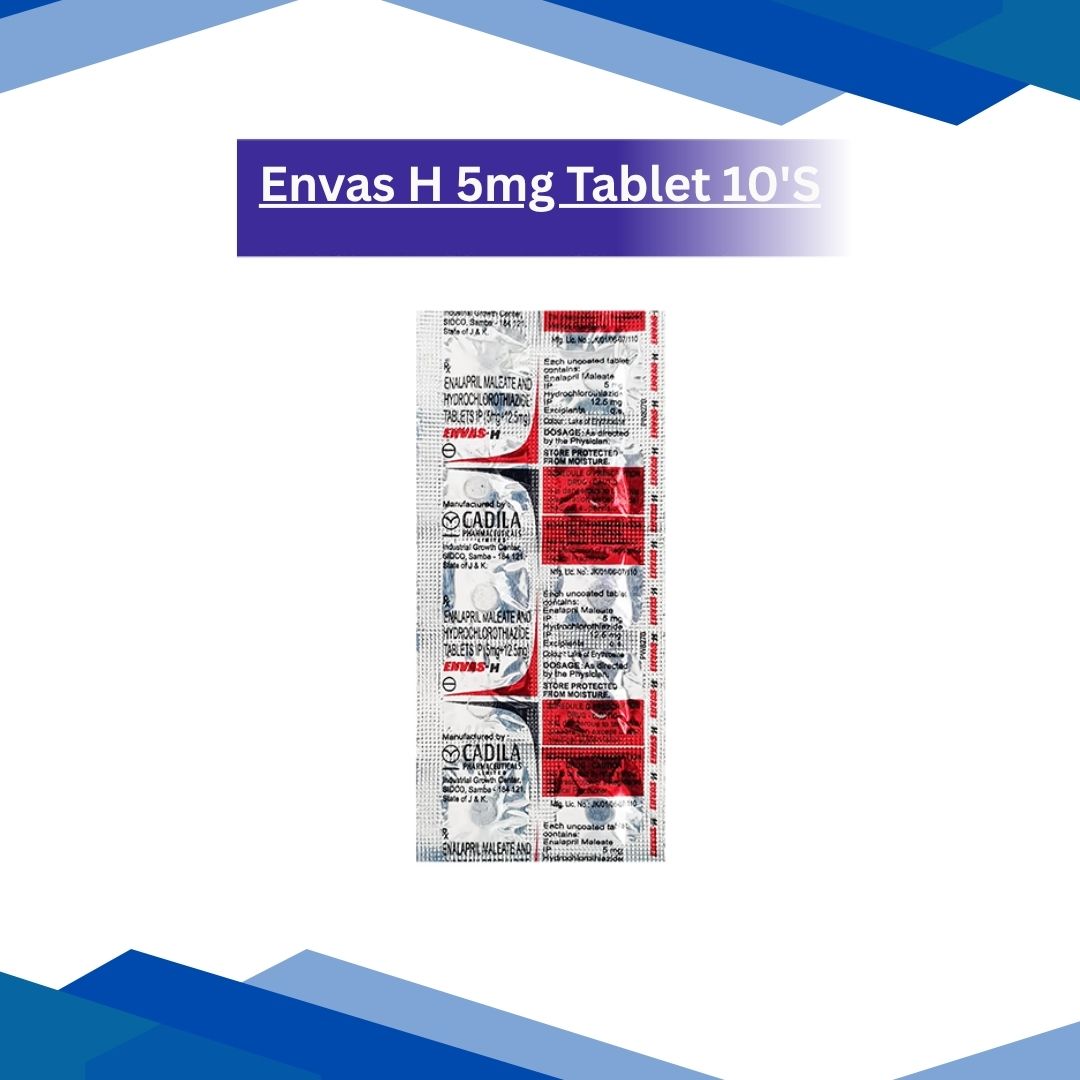
Envas H 5 mg Tablet 10’s
No Prescription yet? Don’t worry! Click Here to Get Online Consultation
Envas H 5mg Tablet 10’s is a prescription medication used to manage high blood pressure. It combines two agents that relax blood vessels and help the body remove excess fluid, thereby reducing cardiac strain. For more details kindly click on Medicine Salts below:
Enalapril
Enalapril: A Trusted Aid for your Heart & Blood Pressure Enalapril is counted among the extensively trusted list of medications that are classified as ACE (Angiotensin-Converting Enzyme) inhibitors. It specifically treats high blood pressure (hypertension) and also congestive heart failure. Enalapril function in such a way that, by widening and relaxing the blood vessels, it makes blood transfer easier for your heart throughout the body, thus decreasing the likelihood of reduced chances of enduring a stroke or heart attack in the long term. Primary Therapeutic Uses Hypertension Control: It decreases elevated blood pressure to protect organs like the kidneys and brain from damage. Heart Failure Management: Ameliorates the condition of an ailing heart's pump, thus reducing symptoms like leg swelling and shortness of breath. Left Ventricular Dysfunction: Typically prescribed after a cardiac event has occurred in order to strengthen and improve heart muscle improvement. Diabetic Nephropathy: Mostly used to help preserve the kidney function in patients with diabetes and early kidney-stress symptoms. Mechanism of Action of Enalapril Enalapril exerts its action as a vasodilator. It blocks the production of the natural substance, Angiotensin II, within the body which otherwise promotes the narrowing of blood vessels. Simply when this natural agent is inhibited, the blood vessels will stay relaxed, the higher blood pressure slides lower, and the heart has to work less. Sheer Importance Usage & Administration with Enalapril Heeding the 'First Dose' Rule: The first dose actually might drop your blood pressure a lot after consuming the medicament for the first time, which is why a lot of prescribers started giving this medicine to their patients at bedtime. Keep Regular Dosing: To fully assure the utmost benefits of enalapril, keep consuming this drug the same time every day, irrespective of having taken it with or without food. Dampness: Drink plenty of water. This step is critical if vomiting or sweating is induced because the latter could additionally drop your blood pressure precipitously on this medication. Avoid Non-currency Substitutes: Many salt substitutes contain potassium. If Enalapril further elevates the potassium level in the blood, better maintain these with an OK from your doc before employing these rule-outs. Frequently Asked Questions Related to Enalapril (FAQ) Q: How long does Enalapril start? A: The purpose of the reduction of your blood pressure could be fulfilled in about an hour post-helping for the first spell. However, some additional weeks of prescribed regimens will be further required to effect a maximum downward force on the high pressure. And remember-this is not to imply, if 'status quo ante' then it is good to stop the regime of enalapril. A regular setting for hypertension may exhibit no outward symptoms. Q: Why do I have this persistent tickling dry cough? A: Indeed, dry, irritating cough is an inquisition dosage side effect; it is more so severe with ACE inhibitors like those contained in Enalapril. Bradykinin is the substance that instigates it. If it is upsetting to your gardener or a rare invalidator of the night's sleep, then talk about getting off to an alternative class of medicine. Q: Can I take Enalapril during Pregnancy? A: One should never consume Enalapril while pregnancy, especially during the second and third trimesters, as it might cause injury to or the death of the developing fetus. Inform your caregiver before planning or already expecting. Q: What should I do if I forget to take a dose? A: Take the dose as soon as you recall. However, if the missed dose corresponds with your subsequent scheduled dose, omit the missed one. Avoid "doubling up" doses just because you have missed one! Q: Any specific food-interaction warning or reaction? A: Enalapril's interaction with most foods is insubstantial. In the case of high-potassium foods (bananas, spinach) brighten up, though, and stay away from grapefruit juice, just in case your doctor doesn't warn against it. Safety & Side Effects Overview Side Effect Frequency Action Dizziness/Lightheadedness Common Get up from a sitting or lying position slowly. If a persisting dry cough is present Common Consult with your physician. Headache Common May recur but will dissipate in the process of medication. Swelling of Face/Tongue Common Seek the nearest emergency clinic, refer any witnesses, and, what else is there to say, inform them that Angioedema is the emergency there! Storage & Handling Dry conditions are fine. If the container comes to any light, that's direct sunlight. Keep thy container completely shut to save it from the humectation. To mind the child or pet, get away from it.
Hydrochlorothiazide
Hyaluronidase Injection: Uses, Side Effects, and Precautions Hyaluronidase is a genetically engineered enzyme that acts as a “spreading agent.” Unlike many drugs that target a specific symptom, its primary role is to enhance the absorption and dispersion of other injected medications. It works by temporarily breaking down hyaluronic acid, a natural “glue-like” substance in the body, thereby making tissues more permeable.
Primary Indications Enhanced Drug Absorption: Often combined with other injectable medications to improve their diffusion and absorption at the target site. Subcutaneous Infusions: Used in rehydration therapy (hypodermoclysis), allowing the body to absorb larger volumes of fluids under the skin. Extravasation Management: Helps disperse leaked drugs from blood vessels, reducing the risk of tissue damage. Aesthetic Correction: Widely used in dermatology to break down or reverse hyaluronic acid-based dermal fillers.
The Ways of Administration Clinical Use Only: Must be administered by trained healthcare or aesthetic professionals. Routes include subcutaneous, intramuscular, or intra-articular injection. Skin Test for Sensitivity: A patch/skin test is required before first use to check for allergic reactions. Hydration: Adequate water intake is recommended before the procedure, unless otherwise advised by your doctor.
Warnings and Safety Precautions Special Warning: Do not inject into areas with infection, severe inflammation, tumors, or open wounds, as it may increase the spread of harmful conditions. Pregnancy and Lactation: Consult your physician before use. The effects on infants are not well established. Drug Interactions: Inform your doctor about all medications, especially Furosemide, Phenytoin, and Corticosteroids, as they may interfere with Hyaluronidase activity.
Possible Side Effects Generally safe when administered properly, but some individuals may experience: Redness or swelling at the injection site Mild itching or hives Seek immediate medical attention if you notice: Difficulty breathing Rapid pulse
Frequently Asked Questions (FAQs) Q: How fast does Hyaluronidase work for dissolving fillers? A: Effects can be almost immediate, with noticeable improvement within minutes to 24–48 hours, depending on swelling and treatment area. Q: Is the procedure painful? A: Most patients feel only mild discomfort or stinging. A topical anesthetic or numbing cream is often applied to make the procedure nearly painless. Q: Can I use Hyaluronidase if I am allergic to bee stings? A: This must be carefully discussed with your doctor. Some formulations may carry a risk of allergic reactions, so a skin test is essential to prevent anaphylaxis. Q: How much natural hyaluronic acid will be affected? A: Some natural hyaluronic acid may be broken down, but the body naturally regenerates it within a few days. Q: How many sessions are needed to remove fillers? A: Usually, one session is sufficient. However, in cases of deep or high-volume fillers, a follow-up session may be required.
At Gem Pharmacy, we make every effort to provide accurate, expert-written, and thoroughly reviewed information related to medicines. However, this information should not be considered a substitute for professional medical advice, diagnosis, or treatment from a qualified doctor.
The purpose of this information is to educate users and improve communication between patients and healthcare professionals. It should not be used to diagnose or treat any condition.
Always consult a certified healthcare professional before taking any medication.


Related products
Triolmezest 40mg Tablet 10’S