
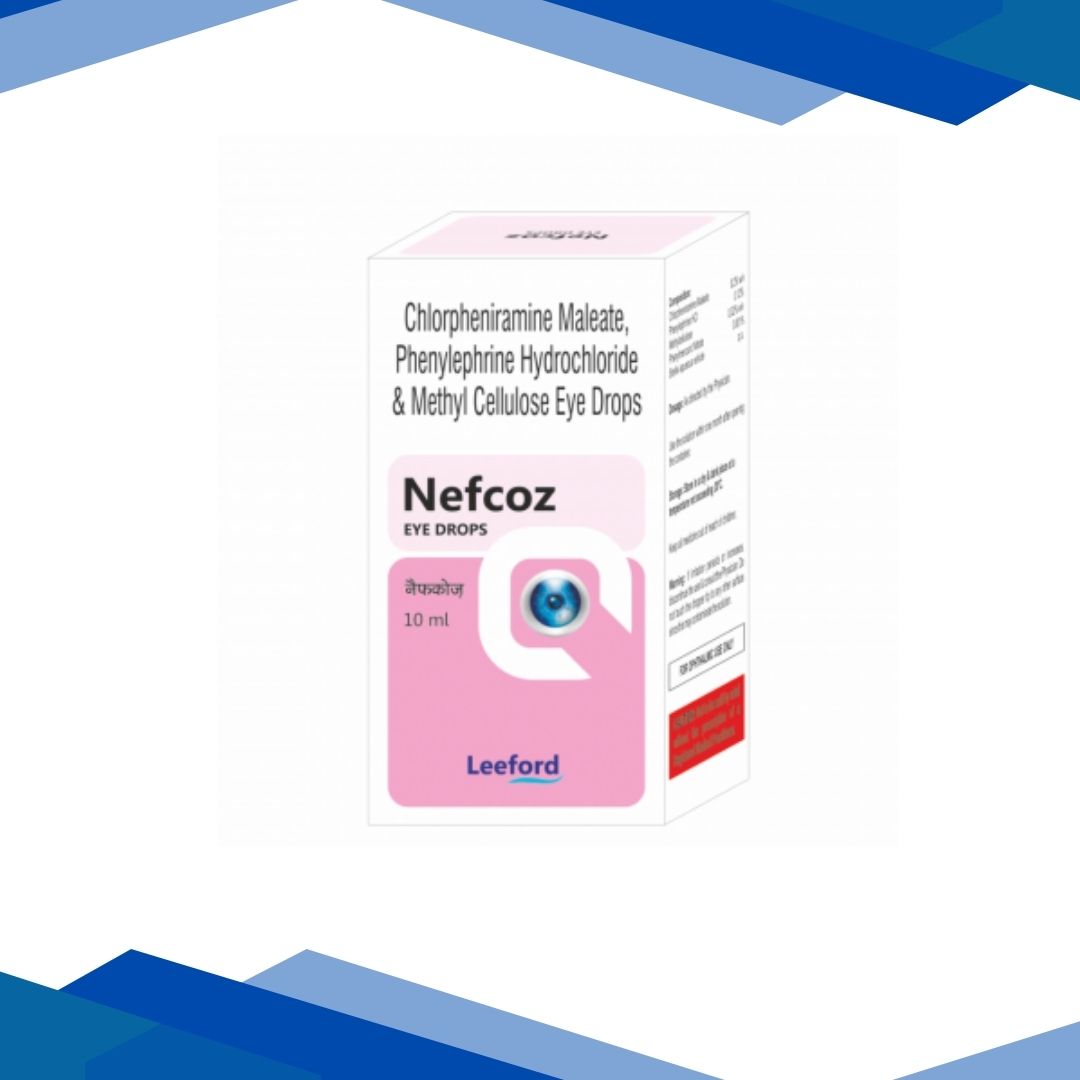
Nefcoz Eye Drops 10ml
No Prescription yet? Don’t worry! Click Here to Get Online Consultation
Nefcoz Eye Drops 10ml is used for relieving redness, swelling, itching and watering of the eyes in allergic eye conditions by reducing irritation and eye congestion. For more details kindly click on Medicine Salts below:
Camphor
Menthol
Menthol (Topical Analgesic)
Menthol is natural ingredient that occurs organically and is extracted from peppermint and other mint oils. It has certain pharmacological properties due to the topical analgesic and counterirritant that is widely utilized in pharmaceutical applications. When applied to the skin, it binds to the cold-sensitive receptor termed TRPM8 nicotine, and thus generates a cooling sensation. It works by producing enough cooling sensation to distract the brain from underlying pain signals, therefore providing some relief, deceiving the skin's pain receptors and authors. It is commonly used in muscle-recovery products and patches to mitigate joint pain.
Primary Indications
Muscle & Joint Relief: Temporary relief of minor aches and pains, caused by arthritis, simple backaches, strains, and sprains.
Counterirritant Action: Provides a cooling, slightly warming sensation with benefits of desensitization of pain nerve endings.
Itch & Irritation Control: Effectively don't entertain the itching from insect bites, sunburn, or minor skin rashes.
Respiratory comfort: Often used in chest rubs to emotionally relieve symptoms of feeling clear airways during common colds.
Post-Workout Recovery: Helps reduce the perception of soreness in overworked muscles and tendons.
The Product Specifications
Drugs Group: Topical Analgesic/ Counterirritant.
Formulations: Gels, sprays creams, ointments, medicated patches are available.
Concentration: Ranges generally from 1% and 16% as per the strength.
Appearance: Clear liquid or white crystalline material, characteristic of a minty aroma.
Instructions of Use
For Pain Relief: Clean and dry the affected area. Then apply a thin layer of gel or cream to the area 3-4 times daily.
Sprays: Spray on the skin evenly from 4" to 6" distance. Do not rub unless otherwise specified.
Patches: Stick one patch to the painful area and leave it for as long as 8 hours. Don't use more than one patch that has formed into a mass.
Hygiene: Wash your hands thoroughly with soap after application to avoid any accidental contact with the eyes and mucosa.
Safety Precautions & Warnings
For external use only: Do not ingest menthol-based topical products.
Avoid Over Broken Skin: Never apply to an open wound, damaged skin, or any irritated rashes.
No Heat therapy: Whether using a heating pad, hot water bottle, or tight bandage applied to the area, do not apply heat either. This will increase permeation and cause severe skin burns.
Flammability: Some menthol sprays and gels are flammable. Keep away from open flames or high heat until the product has completely dried on the skin.
Children: Consult a pediatrician before using on children under 12.
Frequently Asked Questions (FAQs)
Q: How does Menthol actually stop pain?
Menthol does not "numb" the pain as a local anesthetic does, but rather acts as a counterirritant. As the compound creates an intense cold sensation, it blocks the pain signals headed to the brain, effectively turning down the volume on discomfort.
Q: Can Menthol be used with a heating pad?
No. This is a major danger. Menthol causes the blood flow to the skin to increase, and the application of heat tends to make the medication be absorbed too quickly or cause some very bad burns and blisters.
Q: Why do I instantly feel cold but end up feeling warm?
This is essentially because of the 'counterirritant effect.' The menthol first activates the cold receptors, offering initial cooling effects. Then the local circulation is elevated when it is rubbed in, and the now-warm sensation is relaxing tight muscles.
Q: Can Menthol be used with an oral pain medication?
Yes, in practice, no! Since menthol is only used topically, so very little of it penetrates your bloodstream. However, let your doc know if you're on blood thinners, say, on Warfarin, because some of the topical formulations can have methyl salicylate, which can interact with them.
Q: Will the Menthol smell "stick"?
The very minty smell is the strongest during application and then dissipates as the product dries down. I would suggest many "vanishing scent gels" for a more subtle application, if the user prefers it that way.
Naphazoline
Naphazoline Ophthalmic/Nasal Solution
Naphazoline is a sympathomimetic amine that is potent primarily against decongestion topically. It utilizes the narrowing of swollen blood vessels in the eye or nose that causes the redness and blockage to pass away quickly. This medicine works on the instant against circumstances that emerge; thus, when eye drops repair "red eye," it also causes breathing to be reduced in a nasal spray. In that event, Naphazoline, which is acknowledged to act in mere minutes to localize swelling caused by allergy, cold, or environmental irritation, could save the day.
Therapeutic Action
Target: It is to relieve redness from minor eye irritations like smoke, dust, or swimming.
Common: Injection into an infant's nostrils for instant inhalation thus increasing blood flow such as a stuffed cold, hay fever, or sinus infection; provides respiratory relief; OR
Reduction in eye itching and watering given pollen, ragweed, or animal dander.
Mode of Operation
Naphazoline specifically targets alpha-adrenergic receptors lining the conjunctive and nasal blood vessels' smooth muscles upon application. This receptor interaction culminates in vasoconstriction—decrease in blood flow to the region—alleviating redness and the perception of the pressure.
Directions for Use
Eyes: Lean back your head, pull down the lower eyelid, and put 1 or 2 drops in the eye. Close your eyes and touch the inner corner of the eye to spread the drops and press the eyelid against it for about 2 minutes.
Keep your head erect and look straight when administering in the nose. Then tilt it forward gently. Have a hearty sneeze as a blow of one of any nostrils on a tissue. Wash your hands gently with soap and hot water.
Place the cap back on the bottle and store it in a cool place. Never refrigerate this medication. Each bottle should only be used once. Always disinfect the dropper nozzle before replacing the cap. Do not dig your fingers into the nozzle, as this contaminates the dropper and causes infection. Wash the dropper nozzle with rubbing alcohol as often as necessary to disinfect it. Use paper tissue or a clean cloth until dry: never reuse the same material for the next operation. Before putting the cap back onto the bottle, try to ensure all parts are sterilized and dry. Remember that through continuous sterilization, one helps prevent infection from setting in. This method of prescribed application repeats with each dose. Use Naphazoline only when necessary.
How to Deal with Side Effects
Most people experience minor side effects when used correctly; however, some may experience:
Temporary stinging or burning at the site of use.
Blurred vision may occur if the drops are used in the eyes.
Sneezing or a runny nose.
Rebound Congestion: Using Naphazoline for more than three days in a row causes the symptoms to return or become worse.
Pros & Cons
Glaucoma Warning: These patients with narrow-angle glaucoma should avoid Naphazoline as it increases intraocular pressure.
Heart Conditions: Use cautiously with increased blood pressure, heart disease, or hyperthyroidism.
Restricted Duration of Use: Limit use to 3 days; prolonged use can lead to rhinitis medicamentosa.
If wearing contact lenses, remove them before application to the eyes. Do not reinsert your contact lens for 15 minutes further.
FAQs
Q: What is the time frame of Naphazoline working?
Naphazoline is considered as having faster action. Most patients perceive the redness of the eyes or clearing of the nose within 5 to 10 minutes of its application.
Q: Can I put Naphazoline drops into the eye infection?
No, Naphazoline treats only redness and irritation. If the eye is painful, pus discharge occurs in great quantity too, and your vision is affected, you may be having an infection and therefore need immediate attention from an Eye Specialist.
Q: Can it be given to children?
Extremely cautiously in children. It is usually not recommended for children below six years unless specifically prescribed by a pediatrician, as they are more sensitive to its systemic effects.
Q: What if the solution is accidentally ingested?
Naphazoline may be toxic if ingested, particularly in children. In case of accidental ingestion, call an emergency medical center or poison control center immediately.
Q: Can one use this while applying makeup?
It is preferred to apply to the eye before wearing makeup. If makeup has already been applied, avoid touching the lashes or skin of the dropper while applying. This will prevent the deposition of bacteria into the bottle.
Keep in its original container kept at room temperature (15°C to 30°C). Tightly close the container. Keep it away from direct light. Do not apply if it changes color or becomes cloudy.
Acknowledgments: This view is only for references. It cannot be used as medical advice. Consult your physician or pharmacist before using any eye or nasal medicine.
Phenylephrine
Phenylephrine is a powerful sympathomimetic agent used primarily as a nasal decongestant. Phenylephrine works by targeting alpha-adrenergic receptors in the blood vessels of the nasal passages, causing them to constrict. This action reduces swelling and mucus build-up, making it easier to breathe. Phenylephrine is an ingredient found in many OTC/prescription multi-symptom cold and flu remedies and is usually coupled with paracetamol or antihistamines.
Therapeutic uses
Nasal Congestion: Temporary relief from a “stuffy nose,” caused by common cold, hay fever, or other upper respiratory allergies.
Sinus Pressure: Relief of fullness and pressure in the sinuses.
Allergy Symptoms: Aid in managing the nasal symptoms with seasonal allergy support.
Low blood pressure (hypotension) support: Used in clinical settings and given via injections to keep blood pressure in check during specific medical procedures.
Pages resulting in Phenylephrine therapy
Selectivity in Binding & Mechanism of Action
Phenylephrine's effects on various $\alpha_1$-adrenergic receptors make this particular molecule a highly reliable for causing vasoconstriction when these receptors are activated in the vascular smooth muscle in the nasal mucosa which results in a reduction in the volume of the nasal membranes and lower the flow of fluids, thereby providing the widest opening for air to pass way.
Dosage & Administration
Oral Tablets Dosage
Repetitive dosages via a 3-hour interval are usually administered. A maximum of 6 divided doses might be occasionally required in 24 hours.
Nasal Sprays/Drops Dosage
Spray or drip as prescribed into each side of the nostril. The nasal form should not be used for more than three consecutive days to prevent “rebound congestion.”
With Food
May be taken on an empty stomach or with food. Taking with food may alleviation stomach problems, though it is primarily safe without food if it doesn’t show any adverse side effects.
Provoked Adverse Effects of the Chemical
Productivity in terms of treating symptoms of nasal congestion, although phenylephrine can bring about:
Drowsiness can begin after a long period of insomnia initiation.
High palpitational activities
Insufficient movement (slipping or falling)
Dizziness
Headache
Interactions
Advisor: Immediately report such rare occurrences, especially when there is lightheadedness, fainting, or a swift, irregular heart rate.
Precautions & Warnings
Hypertension: It should not be administered to those already suffering from markedly high blood pressure due to potential significant rise in blood pressure, yet if it is essential, such usage must be closely monitored.
Heart disease: Management of heart disorders supports the avoidance of oral phenylephrine use in patients with coronary artery disease. Phenoxybenzamine may hardly be used in those with CVD (coronary vascular disease).
Endocrine: Sympathomimetic agent influences the heart rate and glycemia; careful care will be required for patients with hyperthyroidism and diabetes.
MAOIs: VERY IMPORTANT: Phenylephrine must not be prescribed with MAOI in the prior 14 days. Such combinations may result in a hypertensive crisis.
Frequently Asked Questions (FAQs)
Q: Do you think Phenylephrine causes sleepiness?
Phenylephrine is a stimulant compared to most of the antihistamines that are largely used in medications for colds. This is why it does not make most people tired, but rather alert or even anxious.
Q: Can I mix Phenylephrine with hypertensive medication?
You need to consult with your cardiologist. It squeezes the blood vessels, unexpectedly counteracting the hypertensive reaction of antihypertensive drugs.
Q: Is Phenylephrine just right for a runny nose?
Phenylephrine is mainly used as a decongestant and works on a blocked nose. If you’re experiencing a runny nose or sneezing as your primary symptoms, taking an antihistamine might be better.
Q: Why should nasal sprays with phenylephrine only be used for 3 days?
When nasal decongestants are used extensively, they can give rise to "rhinitis medicamentosa," and the nasal passageways become permanently swollen and dependent on the medication to remain open.
Q: Can phenylephrine be given to children?
Dosage for children is very much dependent on age and weight. When dealing with a child, never ever give adult strength in phenylephrine. Be sure to only use the pediatric preparation according to the prescribing doctor.
At Gem Pharmacy, we make every effort to provide accurate, expert-written, and thoroughly reviewed information related to medicines. However, this information should not be considered a substitute for professional medical advice, diagnosis, or treatment from a qualified doctor.
The purpose of this information is to educate users and improve communication between patients and healthcare professionals. It should not be used to diagnose or treat any condition.
Always consult a certified healthcare professional before taking any medication.


Related products