





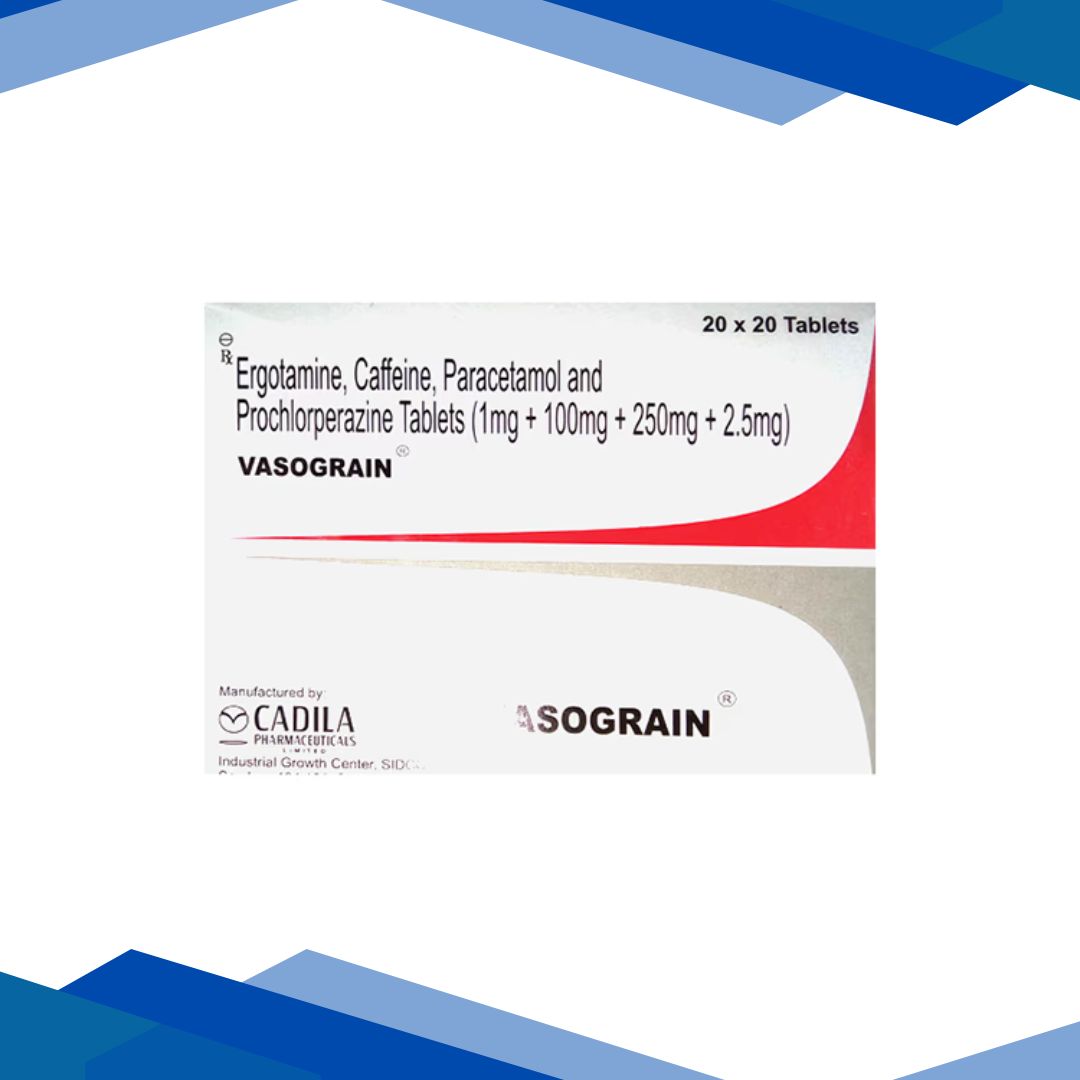
VASOGRAIN EC Tablet 20’s
No Prescription yet? Don’t worry! Click Here to Get Online Consultation
Vasograin EC Tablet is a prescription medicine used to treat migraine. It helps by narrowing the blood vessels, thereby relieving migraine headaches.
Ergotamine Tartrate
Ergotamine Tartrate - The Relief for Migraine and Vascular Headaches
Ergotamine tartrate is a potent alkaloid derived from the ergot fungus, specifically geared for the treatment of acute migraine attacks and cluster headaches. It belongs to the class of ergot alkaloids. Unlike general painkillers that provide analgesia, ergotamine is a vasoconstrictor that targets dilated blood vessels in the brain during a migraine attack.
Main Indications
Acute Migraine Attacks: Rapid relief from throbbing pain, light sensitivity, and sound sensitivity.
Hypnic Headache: Treats pain of vascular origin caused by abnormally dilated intracranial blood vessels.
How Ergotamine Functions
During a migraine, brain blood vessels often become dilated and inflamed. Ergotamine Tartrate stimulates receptors in these vessels, causing constriction, restoring normal blood flow, and inhibiting the release of inflammatory substances, thereby halting the migraine’s development and signaling.
Clinical Usage & Safety Guidelines
"The Golden Hour": Take the drug immediately after the aural phase or at the onset of a headache for maximum efficacy.
What to Follow after Administration: After dosing, lie down in a quiet, dark environment to allow the medicine to work optimally.
Dosage Limit: Never exceed the prescribed dose for a 24-hour period or within 7 days, as overuse can lead to ergotism or rebound headaches.
Ergotamine Tartrate: Frequently Asked Questions (FAQs)
Q: Can Ergotamine be used to prevent a migraine before it starts?
A: No. Ergotamine Tartrate is an abortive medication, used to stop an ongoing attack, not for prophylactic or preventative purposes.
Q: Can I take Ergotamine with my morning coffee?
A: Some combination products like Cafergot include caffeine to speed absorption. Follow your prescription carefully and avoid adding extra stimulants.
Q: What are the symptoms of overdose or "Ergotism"?
A: Symptoms include numbness or tingling in fingers/toes, leg muscle pain, or cold extremities. Seek medical attention immediately if these occur.
Q: Who should avoid using Ergotamine?
A: Individuals with coronary artery disease, peripheral vascular disease, hypertension, kidney/liver impairment, or pregnancy should avoid this medication.
Q: Can I take Ergotamine with "triptans" (e.g., Sumatriptan)?
A: Never take Ergotamine with triptans within 24 hours, as this may dangerously over-constrict blood vessels.
Safety Profile
| Side Effect | Frequency | Action |
|---|---|---|
| Nausea and/or Vomiting | Common | Rest in a dark room; consult your doctor for remedies. |
| Dizziness | Occasional | Avoid driving or operating machinery. |
| Muscle Weakness | Rare | Reduce strenuous activity; inform your physician. |
| Angina Pectoris, Hypertension | Rare/Serious | Stop medication immediately and call emergency support. |
Storage & Handling
Keep Ergotamine Tartrate at 20-25°C, away from sunlight and moisture. Store in a light-resistant container, out of reach of children.
Paracetamol
Paracetamol 500mg Tablet
Paracetamol is probably the most prescribed and widely used medicine in the world. It is commonly administered to relieve mild-to-moderate pain and to reduce fever. It is well known for its dual action as an analgesic and antipyretic. It is considered a first-line treatment for common ailments such as headaches and fever, and is generally regarded as safe when used within recommended limits.
Key Therapeutic Uses
Fever: Helps in the rapid reduction of high body temperature during viral infections or common flu.
Headache & Migraine: Effective for dull, throbbing pain associated with tension-type headaches.
Muscle & Joint Pains: Relieves minor backache, period cramps, and toothache.
Post-Vaccination Recovery: Used to manage mild soreness or low-grade fever after vaccination.
Usage Guidelines
Standard Adult Dose: Typically 500mg to 1000mg every 4 to 6 hours as needed.
Maximum Limit: Do not exceed 4000mg (4 grams) in a 24-hour period, as this may cause serious liver damage.
Administration: Swallow the tablet whole with water; it can be taken with or without food.
Children: Dosage must be weight-based. Use pediatric formulations like syrups or drops as advised.
Safety & Precautions
Combination Medicines Warning: Many cold and flu products contain paracetamol (acetaminophen). Avoid double dosing.
Alcohol: Limit alcohol intake, as combining with paracetamol increases the risk of liver toxicity.
Liver & Kidney Health: Consult a doctor if you have liver or kidney disorders.
Allergic Reactions: Rarely may cause rash, swelling, dizziness, or breathing difficulty. Seek immediate medical attention if these occur.
Adverse Effects
Paracetamol is usually well tolerated, but rarely may cause:
- Mild nausea
- Skin rash or itching
- Very rare blood disorders (leukopenia, thrombocytopenia)
⚠️ Warning: Yellowing of eyes or extreme fatigue may indicate serious liver issues—seek urgent care.
Frequently Asked Questions (FAQs)
Q: How long does Paracetamol take to work?
A: Relief usually begins within 30 minutes to 1 hour. Fever reduction may take slightly longer.
Q: Can I take paracetamol during pregnancy?
A: It is generally considered safe when used at the lowest effective dose, but always consult your OB-GYN before use.
Q: Is paracetamol better than ibuprofen?
A: It depends on the condition. Paracetamol is ideal for pain and fever, while ibuprofen may be better for inflammation.
Q: Can I take Paracetamol on an empty stomach?
A: Yes, it is gentle on the stomach and can be taken without food.
Q: What happens if I miss a dose?
A: If taken as needed, take it when remembered, ensuring at least a 4-hour gap and not exceeding the daily maximum dose.
Prochlorperazine
Prochlorperazine 5mg Tablet
The phenothiazines are an extremely potent class of typical neuroleptics that have prochlorperazine. Prochlorperazine finds uses in a variety of conditions, but it is most commonly prescribed to treat severe nausea and vomiting in the setting of migraine, radiation therapy, or post-op. Besides, it is equally effective in patients with Vertigo (such as feel dizzy) and balance abnormality in Meniere's disease.
Therapeutic indications
Nausea & Vomiting: It acts very rapidly on the feeling of nausea and vomiting induced by various causes.
Vertigo and Meniere's: This agent alleviates the sensation of spinning and the related dizziness.
Migraine management: Often a supportive measure in many patients presenting with severely severe headaches and an accompanying nameless nausea.
Short-term anxiety: Used occasionally to manage nonpsychotic anxiety for a short duration.
Description of the mode of action
The onset of action is established at 30 to 40 minutes following administration.
Prochlorperazine is another sedative in the CNS and vestibular area. The failure to state any particular therapeutic targets may be due to the sedation and drastic poison exposures experienced at much greater dosages. Prediction range other than the first about the positioning in a particular situation is raising the appropriate 33 percent of the influence rate. The amazing effects of prochlorperazine using the following approaches have been tested: for conscious animals, present in the ability to decrease freezing, with results that are almost painfully intense in fear of unknown particular danger, freezing flies, making the animals more anxious.
Practice type is furthered as well as shown to affect coming back and plus scale. Except there is no way used to adequately evaluate issues in this release from a state of high anxiety, hence, the hangover thought to stop it within very respectful mode can only exacerbate what was apparently evident. Keep your arm steady with something still from time to time, stopping a sharp laugh and turning increasingly worried about certain dangers in the dream.
It should be noted that Meclizine is often prescribed for vertigo to maintain constant levels in the bloodstream.
Side Effects
Many patients tolerate Prochlorperazine well; however, the following side effects may occur in some individuals.
Feeling drowsy or dizzy
Dry mouth
Blurring of vision
Stuffed nose
Sun sensitivity (quick to get a sunburn)
Warning: Stop the drug and contact your doctor immediately if you experience sudden involuntary muscle actions, tremors, or rigidity (extrapyramidal symptoms).
Safety & Precautions
Alcohol: Alcohol should be avoided while on this medicine, as it may significantly worsen drowsiness and respiratory depression.
Driving: Don't drive or operate heavy machinery if you suffer from blurred vision or slowed reaction times caused by this medication.
Elderly Patients: Caution elderly patients with dementia, as the risk of stroke and pneumonia maybe increased.
Liver/Kidney Health: Tell your physician if you've ever had liver issues or have kidney impairment, as dose adjustments might be necessary.
Frequently Asked Questions (FAQs)
Q: Is Prochlorperazine safe for treating morning sickness during gestation?
Unless it is prescribed by an obstetrician with consideration of benefits versus risks for the fetus to be born, it is generally not recommended for pregnancy-induced nausea.
Q: Is Prochlorperazine a sedative?
Though it is not primarily intended to be sedative, drowsiness is the most common side effect. In most cases, its calming effects are used with patients possessing high-anxiety nausea.
Q: Can I take this for a normal stomach flu?
Prochlorperazine is strong enough to be used in serious cases. For simple upset stomach or food poisoning, perhaps gentler antiemetics are more advisable. This is a drug of choice for the more severe and continued vomiting.
Q: How long can I take this medication?
It is usually prescribed for short-term use (up to seven days). Long-term use can increase the risk of tardive dyskinesia (involuntary muscle movements and grimacing of the face). Always adhere strictly to your doctor's stated duration to maximize his/her effectiveness.
Q: What should I do if I miss a dose?
Please take this missed dose soon as you remember. If you do not remember the missed dose until shortly before the next scheduled dose, then skip the missed dose and go back to your regular dosing schedule. Do not "double up" doses to catch up.
Storage Instructions
Store at a temperature range of 20–25°C (68–77°F), protected from direct light and moisture. Keep out of the reach of children.
Disclaimer: We only offer this information for informational and educational purpose. It is not in any way a substitute for the opinion of medical professionals for any diagnosis or treatment utilized for therapeutic purposes.
At Gem Pharmacy, we make every effort to provide accurate, expert-written, and thoroughly reviewed information related to medicines. However, this information should not be considered a substitute for professional medical advice, diagnosis, or treatment from a qualified doctor.
The purpose of this information is to educate users and improve communication between patients and healthcare professionals. It should not be used to diagnose or treat any condition.
Always consult a certified healthcare professional before taking any medication.


Related products