










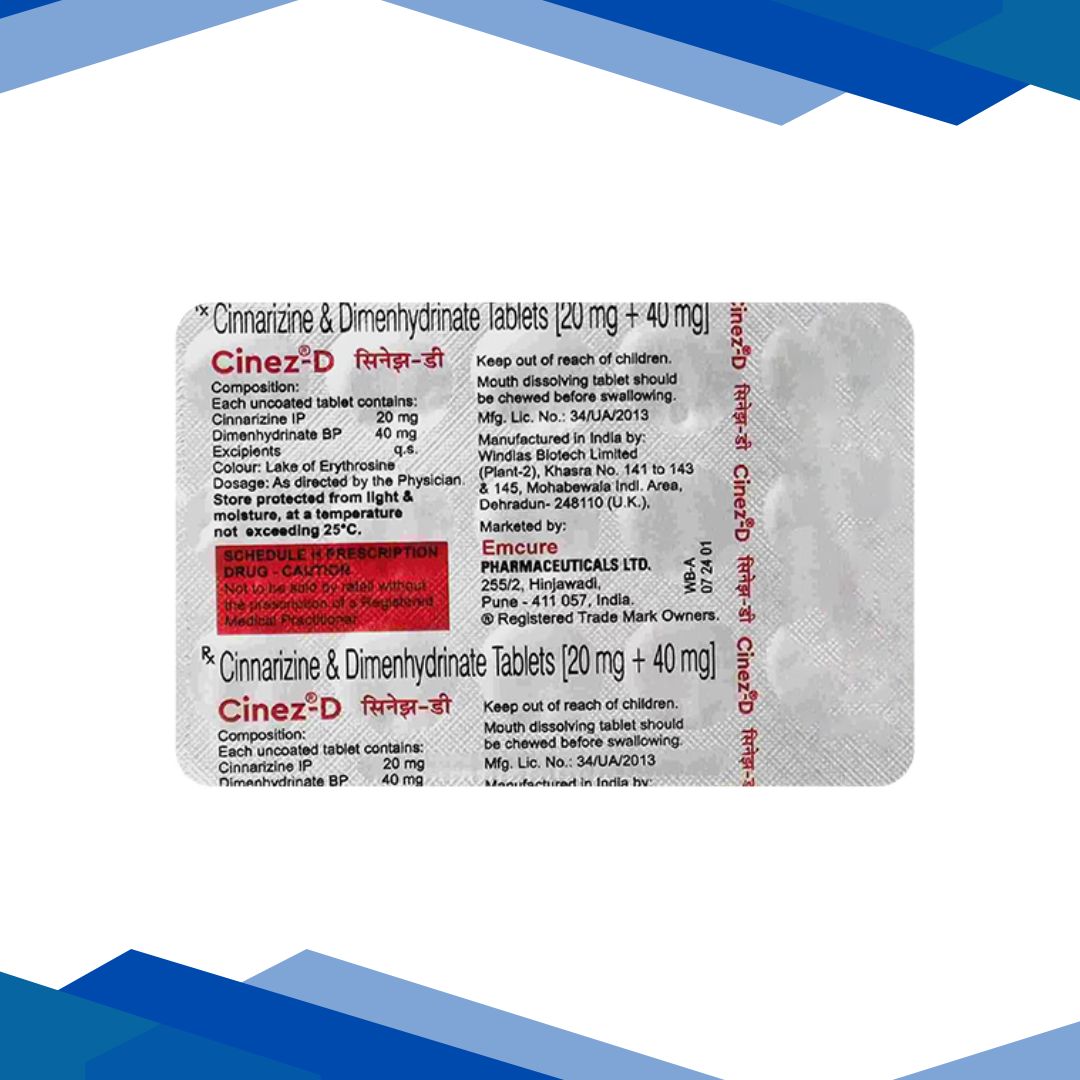
CINEZ D Tablet 15’s
No Prescription yet? Don’t worry! Click Here to Get Online Consultation
Cinez-D Tablet is used to treat vertigo. It is a combination medicine which acts by relaxing vascular smooth muscles of the blood vessels of the ear and improves the blood circulation. It also blocks the action of a chemical messenger that is responsible for lightheadedness in vertigo.
Cinnarizine
Cinnarizine: An Effective Solution for Motion Sickness and Vertigo
This is a specialized antihistamine and calcium-channel blocker that is mostly used to control balance disorders and to alleviate inner ear symptoms. It is a well-known medication for the treatment of Vertigo (the sensation of spinning around) and is highly effective in the prevention of Motion Sickness when traveling. Other than balance or motion-sickness issues, cinnarizine is also administered as a peripheral vasodilator to increase blood supply to the extremities, as it is helpful to patients with Raynaud's disease or chronic cold extremities.
How It Works: The "Shield" for the Inner Ear
Calcium Channel Blocking: It blocks the excessive influx of calcium into the sensory cells of the inner ear, thus "dampening"—as it were—the incorrect signals sent to the brain that trigger a sense of imbalance.
Antihistaminic: It antagonizes the H1 receptors in the centers of the brain involved in vomiting, thereby ameliorating nausea and vomiting in travel and balance disorders.
Blood Circulation Enhancement: Despite being an antihistamine and a calcium-channel blocker itself, it interferes with the aggregation of red blood cells that tend to clog capillaries, thus promoting a smoother blood flow across constricted vessels.
Quick Facts
Category
Specifics
Class
Antihistamine / L-type Calcium Channel Blocker
Commonly Available As:
25 mg, 75 mg (Forte)
Treatment Area
Vertigo, Meniere's, Travel Sickness
Habit Forming
Not
System
H (Prescription Required)
Primary Insurance
Vertigo Control: Effective suppression of "nystagmus" is the chief goal while treating vertigo due to inner ear pathology.
Travel Sickness Prevention: A useful non-fast-acting remedy for those who plan on going by car, boat, or air.
Tinnitus Relief: Somewhat beneficial for people with tinnitus with or without any sharp pain.
Circulation Promotion: Symptoms noted in patients affected by intermittent claudication (pain in the leg upon walking, perceived by some others as small muscle mass) due to circulatory impairment are also benefited.
The Favorite Brands in India
They are commonly used and trusted with respect to this particular drug in the Indian pharmaceutical market. Well-known brands in the Indian market include—
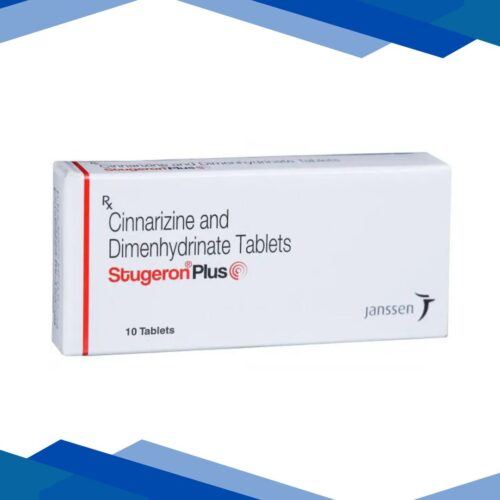
Stugeron (Janssen / Johnson & Johnson)
Vertigon (Abbott)
Cinnzan (Sun Pharma)
Cinzan (Various Manufacturers)
VARTIZINE
Important Safety Information
Patients Note: the watchword in using Cinnarizine for motion sickness is apparently timing the dose; by the time you feel sick, taking it won't work. It should be taken at least two hours before travel, so as to be available when it reaches peak absorption.
Contraindications:
Drowsiness Warning: Cinnarizine usually promotes drowsiness. Do not operate heavy machinery or drive until you know its effect on you.
Alcohol Exacerbation: Excluding alcohol would minimize the danger of further sedation while taking Cinnarizine.
Parkinson's Disease: Kindly inform about your Parkinson's or any tremor diagnosed by a neurologist. Cinnarizine might make those symptoms worse with extrapyramidal effects (i.e., shaking or stiffness).
Prostate: Like many other antihistamines, it is advisable that one use great caution should magnify the size of the prostate, as all antihistamines can induce difficulties in passing urine.
Possible Side Effects
Daytime sleepiness or lethargy.
Dry mouth.
Weight gain (with long-term use).
Indigestion or stomach upset.
Frequently Asked Questions (FAQs)
1. Is Cinnarizine safe for children?
Cinnarizine, at a much lower dosage than that of adults, can be given to children 5 years or older. Consult a pediatrician to determine the proper dosage based on the child's weight.
2. How long can I take Cinnarizine for Vertigo?
For severe vertigo, the duration is usually a few weeks. It is generally NOT meant for long-term use (months) unless supervised by an ENT specialist, as it may lead to drug-induced parkinsonism in elderly patients.
3. High Blood Pressure: I have high BP. Can I use it?
Cinnarizine, as a calcium channel blocker, is not primarily meant for high blood pressure treatment. Therefore, its addition usually does not affect most antihypertensive medications. Always consult your doctor before initiating it.
4. What should I do if I miss a dose?
Take it as soon as you remember. However, if it is nearly time for your next scheduled dose, skip the missed one. Do not take two tablets at once to "catch up."
5. Can I use Cinnarizine during pregnancy?
During pregnancy or breastfeeding, Cinnarizine is generally avoided unless specifically recommended by a doctor. Safer alternatives are usually preferred for nausea during pregnancy.
DISCLAIMER:
This content is for informational purposes only and does not substitute professional medical advice. Cinnarizine is a prescription medicine. Always follow your doctor’s instructions.
Dimethicone
Dimethicone: The Versatile Barrier for Skin Care and Digestive Relief Dimethicone (polydimethylsiloxane) is a silicone-based polymer that is prized in the field for its barrier-building ability yet breathable in action. Its purpose varies from locking in moisture for good skin on the outside to easing abdominal gas from the inside, thus being an indispensable thing to both dermatological and gastrointestinal health.
Primary Therapeutic Uses
I. Advanced Skin Protection
Sacred lock Skin surface: The emollient theological property accelerates the imperceptible gap filling between skin cells, hence depriving dehydration and smoothing the skin surface.
Protective Barrier: Skin is shielded from irritants, weather, etc., and some types of friction.
Skin Conditions Management: Extremely effective for treating skin with xerosis, pruritus, or scaliness and for minor irritations, e.g., diaper rash & burn wounds from radiation.
II. Gastrolyceal Media
Stable grating: Dimethicone was put into antiflatulent oral use and it went with the antacids
Moonlight: A defoamer on the gastrointestinal tract, Dimethicone decreases the tension of bubbles, thus enabling elimination of the bloating feelings and letting the gas and air be expelled to lower enemy internal pressures.
Dimethicone Mode of Action
One central characteristic should be here: Impermeable Dimethicone does not pass into the bloodstream, but rather lies on the surface being treated as follows:
On the skin: it forms a non-greasy water-resistant film that reduces trans-epidermal water loss (TEWL).
In the gut: It does a mechanical impact on the joining of small gas bubbles thereby making them let out with ease in witness is from differing motility.
Experiments Done & Application Tips
If Skin is Dry: Apply a cream or lotion after a bath while it is still slightly damp to seal moisture in.
Using a Diaper Rash: Clean the affected area well and let it dry. Apply a thick layer of Dimethicone ointment.
For Oral Use: Most likely given in liquid drops or chewable tablets to comfort gas; take the dose shortly after mealtimes and/or at bedtime.
Shake Well-Hard: After closing the container, shake it well so that the active ingredient is evenly spread around if you're using a lotion or liquid suspension.
Dimethicone: FAQs
Q: Is Dimethicone safe on sensitive and acne-prone skin?
A: Yes. Dimethicone is non-stinging not liable to clog pores. It is highly recommended for sensitive skin and anesthetic qualities without an oily weight, which has been an excellent alternative to traditional products.
Q: Can I use Dimethicone on my hair?
A: Many hair serums and conditioners have dimethicone included to improve cuts, shine, and provide heat-styling. However, it is supposed to be removed regularly to avoid the buildup of any product.
Q: Does Dimethicone help with scars?
A: Mostly not in erasing a "scar," Dimethicone is a prime basic product in almost all professional scar-management gels. By gelling and keeping scar tissue moist and away from the regular air, healing is thus prompted and the ugly mark can be flattened as time goes on.
Q: Should I be aware of any potential harmful side effects if I have some oral medication for gas?
A: Oral dimethicone(dimethylsiloxane) is well tolerated as it is not absorbed through the mucous membrane. It might cause some slight nausea or very mild constipation in some cases, but this is infrequently observed.
Q: Can I use Dimethicone on an open wound?
A: No. It is fully advisable never to apply a Dimethicone cream over open sores, deep wounds, or animal bites or severe burns without getting professional advice, and it is best used on intact-but-irritated or dry skin visible.
Safety & Precaution
Feature
Details
Allergy Risk
Greatly minimal with adverse reactions; in extreme cases, one may experience facial swelling, severe itch, or a rash.
Pregnancy/Nursing
Use as innately as other topical drugs; The oral form should be a consultational choice.
Drug Interactions
None.
Driver's Specification
Keep Dimethicone or its vehicle between 15°C and 30°C, free from direct sunlight, in a room.
At Gem Pharmacy, we make every effort to provide accurate, expert-written, and thoroughly reviewed information related to medicines. However, this information should not be considered a substitute for professional medical advice, diagnosis, or treatment from a qualified doctor.
The purpose of this information is to educate users and improve communication between patients and healthcare professionals. It should not be used to diagnose or treat any condition.
Always consult a certified healthcare professional before taking any medication.


Related products