
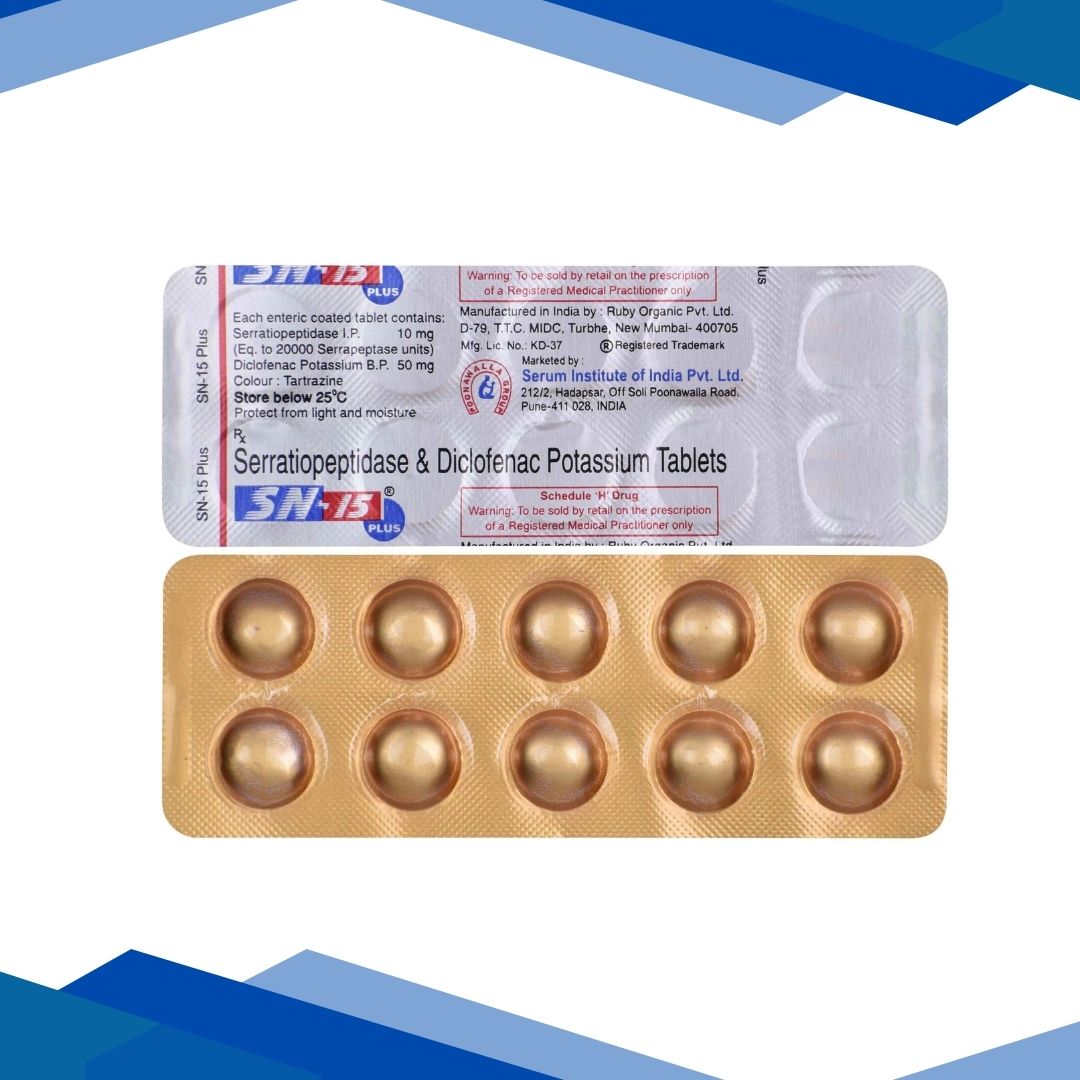
SN 15 Plus Tablet 10’S
No Prescription yet? Don’t worry! Click Here to Get Online Consultation
SN 15 PLUS TABLET is a combination of Diclofenac and Serratiopeptidase which belongs to a group of medicines called Nonsteroidal anti-inflammatory drugs and Proteolytic enzymes. SN 15 PLUS TABLET is used in the management of pain and inflammatory conditions in adult patients. SN 15 PLUS TABLET is not recommended for use in patients allergic to diclofenac, aspirin, ibuprofen, other NSAIDs, and/or serratiopeptidase. SN 15 PLUS TABLET is also not recommended for use in patients with active gastric or intestinal ulcer/bleeding/perforation, active/previous history of recurrent peptic ulcer/hemorrhage, peripheral arterial disease (blood circulation disorder), severe liver/kidney impairment, and/or heart diseases (such as congestive heart failure, severe heart failure, ischemic heart disease). SN 15 PLUS TABLET is also not indicated for use to manage pain in patients who had undergone coronary artery bypass graft (CABG) surgery.
Diclofenac Potassium
Diclofenac-Potassium: Concept for Pain and Inflammation
Diclofenac-Potassium is a widely used Non-Steroidal Anti-Inflammatory Drug (NSAID) available in fast-absorbing tablet form. This medication dissolves more rapidly in the body compared with some other pain medicines, which makes it a preferred choice for acute pain relief. Diclofenac works by blocking prostaglandins, natural chemicals produced by the body that signal pain and cause inflammation and swelling in injured tissues.
Primary Uses
The common indications for prescribing Diclofenac-Potassium include:
Acute Pain: Provides rapid relief from dental pain, post-surgical pain, and minor injuries.
Arthritic Care: Helps manage pain and inflammation associated with osteoarthritis and rheumatoid arthritis.
Menstrual Comfort: Used to reduce the severity of primary dysmenorrhea (menstrual cramps).
Migraine Headache: Can help reduce throbbing migraine attacks, particularly when taken early during onset.
Dosage
For maximum effectiveness, follow the dose prescribed by your healthcare professional. Many individuals prefer to take the tablet with a glass of water after food to minimize stomach irritation. Do not crush, chew, or grind the tablet; it should be swallowed whole.
Safety and Precautions
Category
Advice
Alcohol: Avoid combining alcohol with NSAIDs. Doing so may increase the risk of stomach irritation and gastrointestinal bleeding.
Pregnancy: A doctor’s consultation is essential before using Diclofenac-Potassium. Use during the last three months of pregnancy may pose serious risks to the fetus.
Heart Health: Patients with high blood pressure or a history of heart disease should inform their doctor before taking this medication, as NSAIDs may increase cardiovascular risks.
Liver/Kidney: Regular monitoring may be required to ensure proper liver and kidney function during prolonged use.
Possible Side Effects
Although many people tolerate the medication well, mild side effects may occur as the body adjusts:
Common: Heartburn, gas (flatulence), lightheadedness, or mild headache.
Digestive: Occasional nausea or diarrhea due to gastrointestinal irritation.
Serious and Rare: Stop the medication and seek medical help immediately if symptoms such as black stools, severe stomach pain, or a sudden skin rash occur.
Frequently Asked Questions (FAQs)
1. How fast does Diclofenac-Potassium begin to work?
Because the potassium salt dissolves quickly, many users experience pain relief within 30 minutes to 1 hour. For chronic conditions like arthritis, the full anti-inflammatory effect may take several days of consistent use.
2. Can it be combined with Paracetamol?
Yes, in some cases Diclofenac-Potassium may be combined with Paracetamol for additional pain relief, but it should only be done under medical or pharmacist guidance to ensure safe dosage levels.
3. Can Diclofenac-Potassium be taken on an empty stomach?
Although it can be taken without food, it is recommended to take it with food or milk to protect the stomach lining and reduce irritation.
4. What is the difference between Diclofenac-Sodium and Diclofenac-Potassium?
The main difference is speed of action. Diclofenac-Potassium is absorbed more quickly and is preferred for sudden acute pain, while Diclofenac-Sodium has a slower release and is often used for chronic inflammation management.
5. I missed a dose. Should I take two tablets now?
No. If you remember shortly after missing a dose, take it then. Otherwise, skip the missed dose and continue with your regular schedule. Do not take two tablets together, as this may increase the risk of side effects.
Serratiopeptidase
Serratiopeptidase: A Robust Enzyme for Inflammation Management and Pain Relief
Serratiopeptidase (commonly known as Serrapeptase) is a proteolytic enzyme found in the digestive system of silkworms. It has become a popular drug choice in the medical field for its powerful properties against inflammation and fibrinolysis. Instead of simply acting as a painkiller, which masks the symptoms, it really serves by interfering with the sniping-off of protein accumulation where the inflammation conditions have set in, thereby, minimizing the swelling and facilitating the natural healing course.
Most Common Clinical Applications
Inflammation & Edema: Rapid reduction of swelling post minor surgeries, dental procedures, or physical trauma.
Pain Management: Usually combined with analgesics to relieve pain as a result of arthritis, sports injuries, and back pain.
Respiratory: Acts as a mucolytic to thin down the secretion and break mucus in sinusitis, bronchitis, and asthma.
Post-Operative Recovery: Helps to reduce tissue inflammation and hematoma (bruising) post-surgery.
Carpal Tunnel & Fibrocystic Breast Disease: It helps reduce fluid retention and pressure in sensitive tissues.
Mechanism of Serratiopeptidase Action
Serratiopeptidase is a protein-digesting enzyme; when body inflammation is undergoing, excess fibrin formation (a protein found in blood clotting) occurs, as do other inflammatory by-products. Serratiopeptidase has a strong affinity for this type of nonliving matter, which it celluloselessly dissolves into, thus not in any way harming good tissues. Fluid thinning around the affected area allows for easy drainage and absorption of other medications into the tissue, such as antibiotics.
Administration and Dosage Guidelines
ESR can most effectively be absorbed by taking it while fasting. This requires 30–60 minutes prior to consumption or 2 hours post-consumption.
Enteric-Coated Tablets: Be sure to swallow this medication whole; usually, high-quality formulations will include an enteric coating to prevent enzyme degradation by stomach acid before reaching the jejunum.
A Controlled Dose Schedule: Make sure to take your doses on the exact frequency given to you. Normally, the enzyme is taken one to three times per day, depending on the grade of inflammation.
Serratiopeptidase: Frequently Asked Questions (FAQs)
Q: Is Serratiopeptidase a painkiller?
A: Not quite. This results in pain alleviation when it alleviates inflammation and edema. It is usually paired with NSAIDs (like Diclofenac) to double the attack on pain and inflammation by the two drugs acting synergistically.
Q: How long until I see improvement?
A: Those with acute swelling (e.g., dental extraction) will usually see changes practically within 24–48 hours. Chronic illness like sinusitis or joint pain may need 1–2 weeks for maximal therapeutic benefits.
Q: What side effects should one look out for?
A: Side effects from the use of serratiopeptidase are less likely to happen; yet in one or two people, mild digestive discomfort, a skin rash, or secondary appetite might occur. Unusual bleeding or persistent nausea would require a doctor's visit.
Q: Can I take this if I am on blood thinners?
A: Caution is advised. Hence due to the fibrinolytic effects of Serratiopeptidase, an increased probability of bleeding or bruising when combined with anticoagulants like Warfarin or Aspirin exists. Always prefer to seek medical assistance before utilizing to this effect.
Q: Is it safe for long-term use?
A: It is safe for short-term use. Usage for long periods must be monitored by a doctor for way long it should be taken depending on how your body responds, and if enzyme therapy is still necessary.
Safety and Precautions At a Glance
CircumstanceInstructions
Pregnancy/NursingConsult your doctor; there are limited data on whether it can be employed in breastfeeding.
SurgeryDiscontinue the consumption of the enzyme at least two weeks prior to a planned operation.
AntibioticAvoid in cases of known allergies to Serratia-derived enzymes.
Stomach HealthUse with caution and under a physician's care in patients with a previous history of gastric ulcers.
Quick Comparison: Serratiopeptidase vs. Traditional NSAIDs
Traditional NSAIDs (e.g., Ibuprofen): Inhibit enzymes producing pain chemicals and can cause inflammation in the stomach lining.
Serratiopeptidase: Breaks down inflammatory proteins and debris; if taken correctly, it is gentler on the stomach"s lining than NSAIDs.
At Gem Pharmacy, we make every effort to provide accurate, expert-written, and thoroughly reviewed information related to medicines. However, this information should not be considered a substitute for professional medical advice, diagnosis, or treatment from a qualified doctor.
The purpose of this information is to educate users and improve communication between patients and healthcare professionals. It should not be used to diagnose or treat any condition.
Always consult a certified healthcare professional before taking any medication.


Related products