
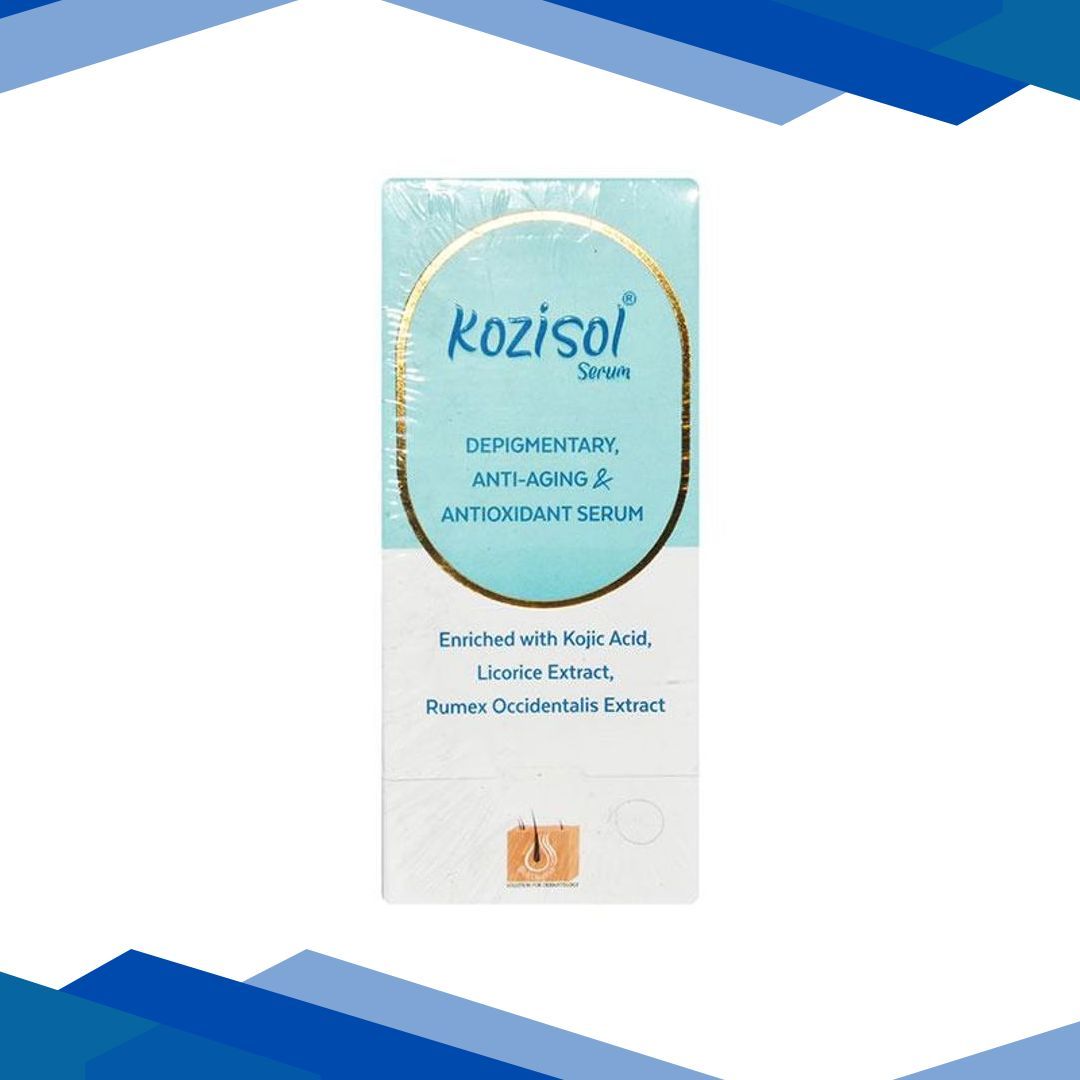
KOZISOL Serum 15ml
No Prescription yet? Don’t worry! Click Here to Get Online Consultation
Arbutin + Kojic Acid is a skin-lightening combination commonly used to treat hyperpigmentation, dark spots, melasma, and uneven skin tone. It works by inhibiting the enzyme tyrosinase, which reduces melanin production in the skin. This helps brighten the complexion and gradually fade discoloration for a more even skin tone.
Citric acid
Citric Acid: Uses, Formulation Roles, and Benefits
Citric acid is an organic acid that is found naturally in citrus fruits like oranges and lemons. This makes it a versatile excipient and active ingredient in pharmaceutical formulations. Most importantly, citric acid is widely used in effervescent tablets, urinary alkalizers, and stabilization agents that ensure therapeutic products remain potent over time. Apart from these benefits, when treated as potassium citrate or sodium citrate, citric acid becomes vitally important in treating metabolic conditions and in preventing the stomach from generating specific types of kidney stones.
Why Do People Use Citric Acid in Medicines?
Urinary Alkalization: It helps to raise the pH of urine, making the urine less acidic, which is very necessary for those who are prone to uric acid or cystine stones.
Effervescent Action: Have you ever noticed that some tablets fizz in water? Citric acid and bicarbonate react in the water giving it the "fizz" feeling while expediting the dissolution of the medicine and thereby facilitating rapid absorption in the stomach in the process.
Antioxident: It stabilizes the drug molecules, acting as a preservative which prevents oxidation and other harmful decay related to susceptible medicine substances.
Enhanced Mineral Absorption: It is routinely combined with either Calcium or Magnesium (again in the form of Calcium Citrate) to increase the uptake of these essential minerals out of the intestines.
Getty Images
The better view and quick education
Feature
Details
Drug Class
Urinary Alkalizer / Pharmaceutical Excipient
Common Forms
Powder, Oral Solution, Effervescent Tablets
Primary Indication
Kidney stone prevention, Acidosis, pH Balancing
Source
Naturally derived or biotechnologically produced
Safety Guidelines & Expert Advice
Although Citric Acid is classified as "Generally Recognized as Safe" (GRAS) by global health regulators, it does require careful use when used as a medicine.
How to Take:
It Is All About Dilution: If taking with a liquid, Citric Acid/Citrate must be diluted in a minimum of 6 ounces of water or some irresistible juice, so it does not irritate the stomach and does not harm the teeth.
After Meals: It is advisable to take the medicine after meal(s) or even when going to bed, as to ensure that you do not have any malaise in the stomach.
Fluid Intake: Hydration must be maintained while under treatment with citrate-based medications in order to help the kidneys flush out many more waste materials.
Restrictions:
Kidney Malfunction: You should consult a renal expert first before using Citric Acid if you experience severe kidney diseases, as it can affect potassium and sodium levels.
Oral Hygiene: Prolonged utilization of acidic solutions may ultimately have an adverse impact on the teeth by demineralizing them. It is best to rinse your mouth with water following the ingestion thereof.
Frequently Asked Questions (FAQs)
1. Can Citric Acid cure active kidney stones?
The primary use of citric acid is more prevention, rather than in cases of actual treatment of large stones. By making the urine less acidic, it stops further crystal formation and helps pass through the smaller "gravel."
2. Can I get enough Citric Acid from lemons?
In an average healthy condition, lemons might be enough; however, for cases like Renal Tubular Acidosis, the concentration in the pharmaceutical grade (like Potassium Citrate) provides relatively controlled dosing. This ensures that the dose remains more consistent than just having the food as a source.
3. Are there any side effects?
Some people might experience temporary mild gastrointestinal symptoms, like nausea, stomach cramps, or diarrhea, which can usually be prevented by supporting the treatment with an abundant volume of water and food consumption.
4. Is it safe for patients with hypertension?
Patients with hypertension trying to keep their sodium intake low should look into the use of sodium in order to avoid too much from Citric Acid. With that being the case, Potassium Citrate would become a better substitute in such instances.
5. Can I take it with antacids?
Taking the citric acid and antacids simultaneously would cause aluminum in the antacid to be absorbed in excess, leading to toxicity. Hence, the best option is to avoid combining Citric Acid with antacids, especially if the latter contains aluminum.
Glycerin
Hyaluronic Acid
Hyaluronic Acid: The Gold Standard in Hydration of Molecular Weight and Tissue Reconstruction Hylauronic Acid (HA) is a high-molecular-weight glycosaminoglycan found naturally throughout the human body in connective, epithelial, and neural tissues. Among its many functions, it is an important component of the extracellular matrix (ECM), where it acts as the principal structural scaffold. Its outstanding absorption capacity has made this chemical a marvel; it is capable of holding more than 1,000 times its weight in water. It is, therefore, truly a hero when it comes to maintaining dermal volume, joint lubrication (synovial fluid), and ocular surface health.
Therapeutic Benefits and Clinical Profile
Multilevel Hydration: It is a very powerful humectant that can secure moisture from the environment in the stratum corneum, making the skin look fuller, thus much lessening the appearance of fine lines (rhytides).
Viscoelastic Joint Support: In orthopedic joint applications (viscosupplementation), HA helps in fluid between joints and as shock absorber, relieving pain for osteoarthritic patients and saving the joint cartilage from deteriorating.
Wound Healing Acceleration: By decreasing the inflammation levels and signaling the body to build more blood vessels in the injured area, it accelerates the dermal repairing process.
Post-Surgical Recovery Period: It is used for soothing in the dermis after laser irradiation or during dermal peeling and to prevent Transepidermal Water Loss (TEWL).
A Pharmacy Insight: Approach the Issue Concerning Molecular Weight
It doesn't all fall into the same category of Hyaluronic Acid. The main consideration is the size of the molecule:
Molecular Weight | Scientific Name | Depth of Action | Main Benefit
High (HMW) | Hyaluronic Acid | Surface Layer | Allows formation of a breathable film; immediate hydration
Medium (MMW) | Sodium Hyaluronate | Mid Epidermis | Strengthens the natural barrier of the skin
Low (LMW) | Hydrolyzed HA | Deep Dermis | Long-term repair; has a role in triggering collagen synthesis
Dose and Usage
Topical Application: Always apply HA serums on damp skin to maximize the latter's effects. As a humectant, it needs to "pull" moisture into the skin, and if applied on extremely dry skin in a dry climate, it can actually dry it out.
Layering: Use an occlusive moisturizer containing ceramides or oils to hold the hydration into the skin.
Oral Supplementation: Doses typically range between 120–200 mg/day for promoting joint health and systemic skin moisture.
FAQs
1. Will Hyaluronic Acid exfoliate my skin since it contains an "acid"? No—it is a polysaccharide—a type of sugar—so it is not an exfoliating acid like Glycolic or Salicylic acids. It hydrates rather than peels the skin and is suitable for all skin types, including sensitive or rosacea-prone skin.
2. Can it be combined with Vitamin C and Retinol? Yes. It works well alongside "active" ingredients. Retinol can cause dryness and peeling, and hyaluronic acid helps maintain hydration without reducing its effectiveness.
3. Why do many serums show "Sodium Hyaluronate" and not Hyaluronic Acid on the labels? Sodium Hyaluronate is a salt form of hyaluronic acid with a smaller molecular size, allowing deeper penetration. Many formulations combine both for multi-layer hydration.
4. Will I get greasy with my oily skin? Not at all. HA is oil-free and typically formulated as a light water-based gel. It hydrates without adding oil, making it ideal for oily or acne-prone skin.
5. Will HA serum work as a replacement for injectable fillers? Topical HA cannot provide structural "lift" like injectable fillers. However, consistent use improves skin texture and hydration, potentially extending intervals between clinical treatments.
Quality/Standard Control
Purity: Our formulations do not contain parabens or synthetic fragrances, making them suitable for compromised skin barriers.
Storage: Store the bottle in a cool, dry place. Avoid hot and humid environments like bathrooms, as temperature fluctuations may affect molecular stability.
Note: This content is intended for informational purposes only. For severe dermatologic conditions or joint injections, consult a licensed medical professional.
Kojic Acid
Kojic Acid (Dermatological Grade) with Kojic Acid being a nature-based chelation agent sourced from different fungi types such as Aspergillus oryzae, it has become a very essential skin-lightening agent of great repute practiced and instituted in the famous dermatological set. It works by inhibiting the production of free tyrosinase, an enzyme indispensable in the melanin synthesis process. Consequently, it reduces the melanin production pace and is proficient at treating various types of hyperpigmentation, melasma, and age spots. It is a perfect advocate for equalizing skin color and facial sheen.
Primary Benefits
Reduction of Hyperpigmentation: Discoloration, sun damage, and various forms of post-inflammatory hyperpigmentation caused by acne are toned down.
Treating Melasma: It is often recommended as a safe substitute for hydroquinone to manage inherently hormonal darkening of the skin.
Anti-Aging Effects: With respect to liver spots and age spots, the skin display will look young.
Skincare: It helps in preventing common skin infections because of its antibacterial properties while fighting against the trigger-causing bacteria that results in acne.
Formulation Specifications
Popular Forms: Cream, Serum, Soap, Concentrated Powder
Standard Concentration: Ranges at $1%$ to $4%$ typically for safety concerns for topical applications
Main Ingredients: Usually mixed with vitamin C or glycolic acid for better effect
Skin Compatibility: Suitable for most skin types, including oily and combination skin.
Application Guidelines
Cleanse: Cleanse your face with a mild cleanser and dry.
Apply: Apply pea-sized Kojic Acid cream or serum spot with pigmented darkened areas.
Absorption: Massage gently till skin completely delivers the product
Frequency: Begin by applying once per day to your face at night; if well accepted by the skin, apply twice daily.
Caution/Warnings
Sun Sensitivity: Kojic Acid makes skin particularly vulnerable to UV damage. It is mandatory to apply a broad-spectrum sunscreen (SPF 30 or more) during the day patch test.
A patch test should be performed on the inner forearm for 24 hours before full facial application to exclude irritation.
Avoid Using Broken Skin: Do not apply to open wounds, active rashes, or severely irritated skin.
Contact Dermatitis: If you experience persistent redness, itching, or a burning sensation, stop using and consult a dermatologist.
Frequently Asked Questions (FAQs)
Q: How long does it take to see results from Kojic Acid? Visible lightening of dark spots may take 4 to 6 weeks of consistent daily use. For deeper pigmentation like melasma, it may be 3 months before substantial improvement appears.
Q: Can I use Kojic Acid with Vitamin C? Yes, they can be combined because Kojic Acid and Vitamin C are much stronger and very good together for brightening the skin and for protection against oxidative stress. Many high-end serums mix them for better results.
Q: Is Kojic Acid a bleach? Kojic Acid does not bleach at all. Unlike the harsh chemical bleaches that destroy the melanocytes, Kojic Acid simply decreases the enzyme that produces melanin, thereby proving much safer for long-term use.
Q: Can I use Kojic Acid soap on my body? Kojic Acid soaps are effective in instructing for use on the body to help even out skin tone in areas like darkened underarms or inner thighs. However, ensure you follow with good moisturization after using these soaps to combat the drying effect.
Q: Is it safe to use during pregnancy? Kojic Acid is presumed to be safe as compared to using hydroquinone, however, speak with your dermatologist or OB-GYN prior to deploying any active skin-lightening product during pregnancy or breastfeeding to keep your babies well-protected.
Treatment SisQuombat Results
In order to inhibit the re-occurrence of dark spots, pair your Kojic Acid treatment with a moisturizer containing Niacinamide. The latter reinforces the skin barrier and stops the movement of pigment to the skin surface, making the perfect complement to Kojic Acid inhibition mechanism.
Disclaimer: The information shared here is for education only and should in no way substitute for the experience and guidance of a medical professional. Always consult a qualified dermatologist before solely hitting off a new skincare regimen.
Licorice Extract
At Gem Pharmacy, we make every effort to provide accurate, expert-written, and thoroughly reviewed information related to medicines. However, this information should not be considered a substitute for professional medical advice, diagnosis, or treatment from a qualified doctor.
The purpose of this information is to educate users and improve communication between patients and healthcare professionals. It should not be used to diagnose or treat any condition.
Always consult a certified healthcare professional before taking any medication.


Related products
Pears 98% Pure Glycerin Detoxed Glow Body Wash 250 ml

Kinactif Rich Nourishing Shampoo