




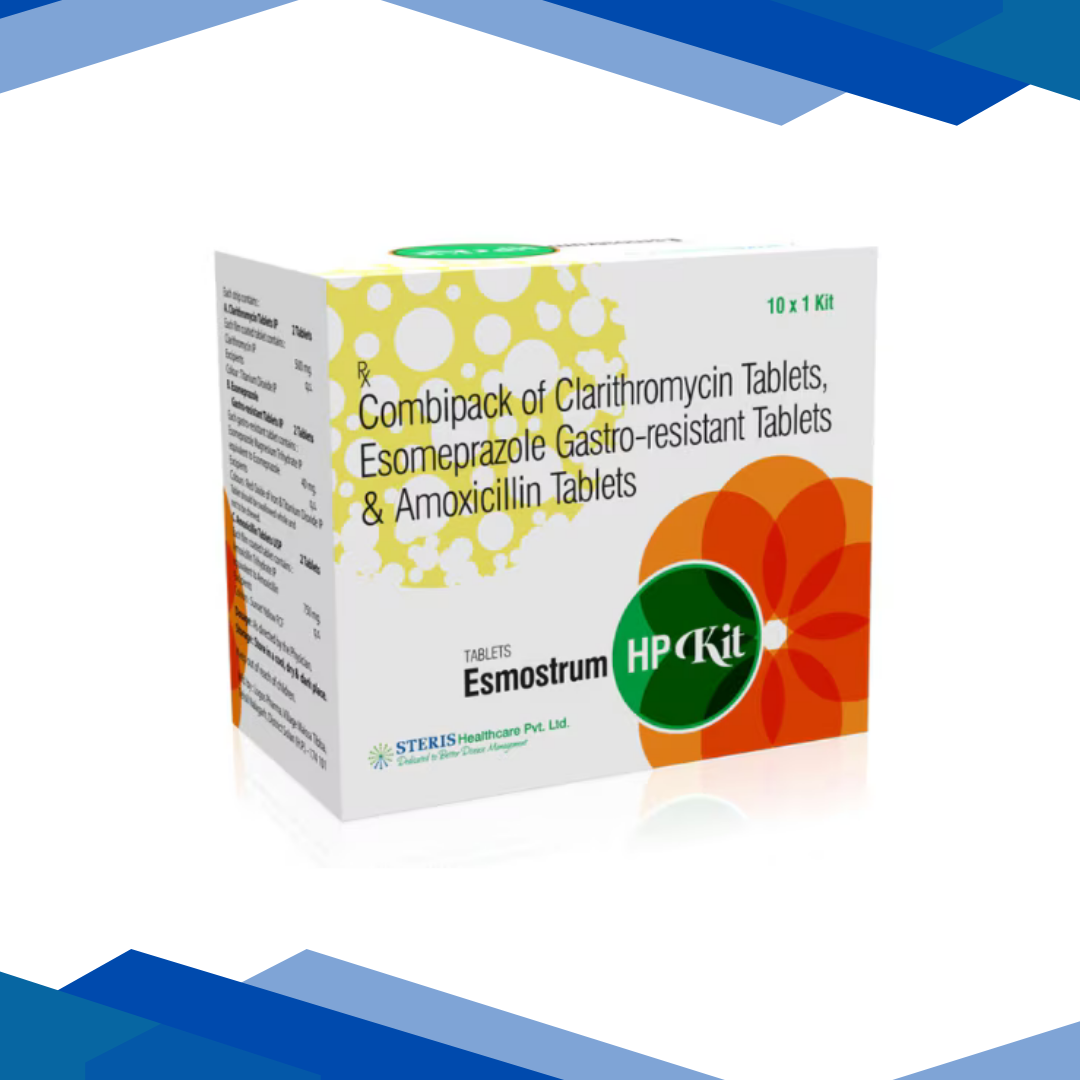
Esmostrum HP kit
No Prescription yet? Don’t worry! Click Here to Get Online Consultation
Amoxicillin and clarithromycin are antibiotics used together to treat bacterial infections, including H. pylori–related stomach ulcers. Esomeprazole is a proton pump inhibitor that reduces stomach acid, helping heal ulcers and prevent acid-related damage. For more details kindly click on Medicine Salts below:
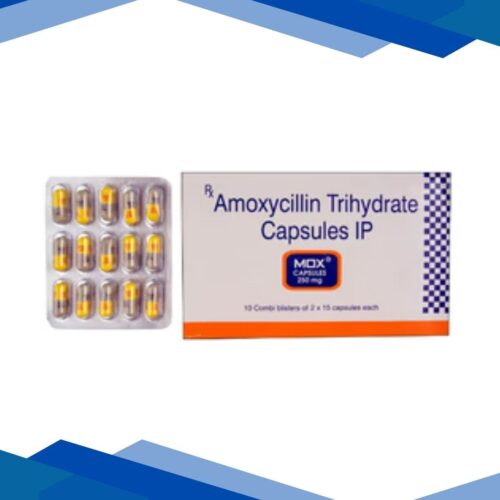
Amoxicillin
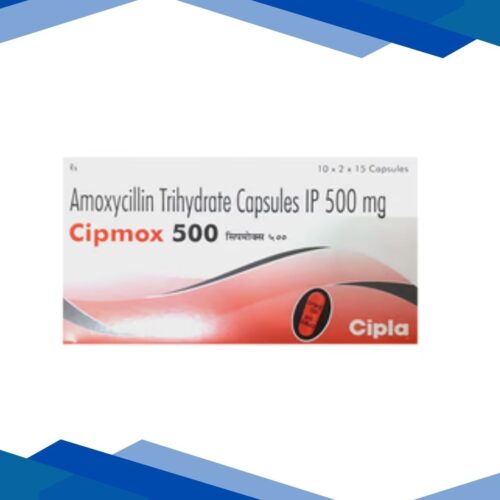
Amoxicillin 500 mg capsule
Amoxicillin is a broad-spectrum penicillin-type antibiotic used to treat a wide variety of bacterial infections. It works by stopping the growth of bacteria by inhibiting the formation of the bacterial cell wall. This medicine works satisfactorily against middle ear infection, tonsil infections, and throat infections such as laryngitis, bronchitis, pneumonia, urinary tract, and the skin.
It is often combined with other medications to treat stomach ulcers resulting from H. pylori-caused infections.
Therapeutic Uses
Respiratory Tract Infections: Pneumonia, bronchitis, and sinusitis are effectively treated if caused by susceptible organisms.
ENT Infections: With otitis media (middle ear infection) and streptococcal pharyngitis (strep throat).
UTIs: Bladder and kidney infections.
Skin & Soft Tissues: For infected wounds, abscesses, or cellulitis.
Dental Abscesses: Another medication prescribed by dentists to clear up infections before or after procedures
Notable Features
High Bioavailability: Starts acting within 1-2 hours and then peak in the bloodstream.
Dose Flexibility: Available in these three forms for oral administration—capsules, tablets, and suspensions for children.
Acid Stability: This member of the penicillin family is acid-resistant compared to older penicillins. This contributes hugely to its effectiveness against pathogens once it is taken orally.
How to Take Amoxicillin
Regular Doses: Have the pill with regular time intervals (every 8 and 12 hours) to get proper drug steadiness in the plasma.
With or without food: Taken with or without food might make Amoxicillin more beneficial to the patient. However, for those patients who get an upset stomach from the medication, taking it with a small meal can alleviate this.
Complete Treatment: Patients are required to consume their last pill even if the symptoms seem to be gone in 2-3 days."errupting treatment uses those surviving bacteria, causing them to magnify antibiotic resistance.
Most Common Side Effects
There are so many people who tolerate Amoxicillin, but some may exhibit:
Vomiting or Nausea
Diarrhea
Rash
Dizziness
Change in Taste
Warning: Get immediate first aid if you develop rash, swelling of the lips, the face/throat, breathing difficulty, this being a sign of life-threatening allergic reaction (anaphylaxis).
Precautions & Warnings
Penicillin Allergy: Avoid using if allergic to penicillin or cephalosporin antibiotics.
Kidney Health: Administer it carefully in patients with severe kidney problems to avoid the drug building up.
Contraception: Use the backup as such pills may be less effective while taking Amoxicillin.
Mononucleosis: In individuals suffering from "Mono," Amoxicillin usually causes a non-allergic reaction like a skin rash. Be sure to discuss with your GP.
Frequently Asked Questions (FAQs)
Q: Will Amoxicillin help with common cold or flu?
No. Amoxicillin is an antibiotic effective for the treatment of bacterial infections. Common cold, flu, and most coughs are viral infections. Using antibiotics to treat viral infections is ineffective and promotes antibiotic-resistant bacteria.
Q: What should I do if I miss a dose?
You should take it as soon as you remember. However, if the time for your next dose is around the corner, then it is better to miss the missed dose. It would not be "doubling up" the dose.
Q: Can I drink alcohol while taking Amoxicillin?
Although it is not contraindicated to have Amoxicillin-alcohol drinking together, alcohol will increase the risk of the side effects of Amoxicillin like dizziness and stomach upset. You are generally advised to avoid alcohol until you are rid of the infection.
Q: How quickly will I feel better?
A majority of patients begin to show improvement within 48-72 hours, although the bacteria may not be entirely rid of from the system, which is determined by taking the full course of recommended treatment.
Q: Does the use of Amoxicillin cause yeast infections?
Yeast infections ubiquitous with females, could be caused by the casual use of antibiotics. Vaginal infections are communicated because of an imbalance of bacterial flora in the vicinity. If you observe a discrepancy from the normal discharge or jitters, check with your healer before opting for self-treatment.
Clarithromycin
Clarithromycin 500mg Tablet
Clarithromycin is a broad-spectrum antibiotic of the macrolide group, which brings out strong influence in bacterial infections by inhibiting the synthesis of essential proteins. It is highly selective against infections of the respiratory tract, skin, and ear and is a companion drug in the treatment of gastric or middistal ulcers caused by H. pylori.
Indications
Upper Respiratory Tract Infections: Has been effective for treating tonsillitis, pharyngitis, and acute sinusitis.
Lower Respiratory Tract Infections: As a response to community-acquired pneumonia, and acute bronchitis.
Skin and Soft Tissue: For the treatment of uncomplicated skin infections and folliculitis.
H. Pylori Eradication: Used in triple therapy in combination with an additional antibiotic and proton pump inhibitor to treat peptic ulcers.
Prophylaxis of Mycobacterium Avium Complex in immunocompromised patients.
Pharmacology & Mechanism
Clarithromycin works by binding to the 50S ribosomal subunit of bacteria that it is susceptible to. This interrupts amino acid movement, thereby inhibiting bacterial protein synthesis. Since this drug attacks the bacterial ribosomes rather than the human ones, it is highly selective and effective at lower concentrations.
Dosage & Administration
Standard Adult Dose: 250 mg to 500 mg, Administered twice daily, depending on the patient's condition
Consistency means taking the medication daily at the same time to assure a therapeutic steady-state concentration in the bloodstream.
Food Intake: This medicine can be ingested with or without food. However, taking the drug with a meal may help to prevent stomach upset.
Extended Release (ER) Versions: If the patient is prescribed the extended-release oral dosage form (XL or ER) do not crush or chew the tablet; swallow it whole.
Common Side Effects:
Most side effects are gastrointestinal and is usually fast to resolve as the course is finished:
Nausea or stomach pain
Diarrhea
The taste of maalox (Dysgeusia)
Headache
Indigestion
Caution: If you start having severe persistent diarrhea, fever, or abdominal cramps, stop using clarithromycin and call your physician without delay, as such symptoms may denote infection with C. difficile.
Interactions
Clarithromycin interacts with many other drugs. Inform your physician if you are on:
Statins: (e.g., Atorvastatin, Simvastatin) as the risk of muscle damage may increase.
Blood Thinners: (e.g., Warfarin) as the risk of bleeding may increase.
Heart Drugs: (e.g., Digoxin or Quinidine).
Colchicine: The combining of two drugs may result in serious toxicity, particularly when patients have kidney problems.
Frequently Asked Questions (F. A. Q.s)
Q: Is Clarithromycin a penicillin-based antibiotic?
Upon further information from clinical colleagues, no cut-off date exists after which alcohol should not be consumed when taking macrolides. However, all of the reviewed protocols suggest avoiding alcohol consumption for a more effective treatment.
Q: Does erythromycin or clarithromycin cause thrush?
Thrush is an illness that could be seen resistant to regular treatment for its rampancy when we spoke to at least five patients about one or two occurrences in their lives. In fact, they said this usually happens during a regime of taking an antibiotic such as erythro or clarithromycin but are unsure whether switching from one to the other could prevent its recurrence.
Q: How can you tell apart a clarithromycin from itraconazole pill?
Though it is hard to tell one tablet from another without reading the label due to their relatively similar shape and sizes, they will surely have different trade names printed on them.
Q: What is the busy passage of clarithromycine that must be memorized thanburry?
In addition to enhancing the actions alcohol does not diminish the effectiveness of Clarithromycin. But alcohol exacerbates its side effects on a complete dose of dizziness and upset stomach and hence it is better to completely avoid alcohol for infection recovery.
Esomeprazole
Esomeprazole is a powerful gastric acid reflux inhibitor (PPI) that functions to control conditions caused by excess stomach acid secretion. It is an "S-isomer" (a purified structure designed for more targeted and prolonged acid suppression). Esomeprazole works by stopping acid production at its source, allowing the damaged lining of the stomach and esophagus to heal from irritation and corrosion.
Mechanism of Action: Pump Blockade
Selective Action: The drug inhibits the $H^+/K^+$-ATPase enzyme system (acid pump) at the secretory surface of gastric parietal cells.
Environment of Healing: By maintaining a higher gastric pH, it creates a favorable environment for healing erosive esophagitis and peptic ulcers.
NSAID Protection: Patients taking NSAIDs like Ibuprofen or Naproxen are often prescribed Esomeprazole to prevent gastric irritation and ulcer formation.
Quick Briefing About the Product
Feature
Details
Drug Class
Proton Pump Inhibitor (PPI)
Common Forms
Tablets, Delayed-Release Capsules, Injections
Standard Strengths
20 mg and 40 mg
Dosage Timing
At least 30–60 minutes before breakfast
Prescription
Schedule H Drug
Primary Medical Indications
GERD (Gastroesophageal Reflux Disease): Helps relieve persistent heartburn and acid regurgitation.
Erosive Esophagitis: Promotes healing of the esophageal lining damaged by acid.
Peptic Ulcers: Used in treating gastric and duodenal ulcers, especially those linked to H. pylori infection.
Zollinger–Ellison Syndrome: Manages rare conditions involving excessive acid production.
Common Brands in India
Esomeprazole is widely used in India for gastrointestinal care. Popular brands include:
Nexpro (Torrent Pharmaceuticals)
Esomac (Cipla)
Sompraz (Sun Pharma)
Izra (Zydus Cadila)
Esole (Leeford)
Directions & Safety
The "Golden Rule" of Taking PPIs:
Esomeprazole works best when taken on an empty stomach. Taking it with food reduces its effectiveness because acid pumps are already active before the drug can act.
Patient Counselling
Consistency is key. Take the medication at the same time daily for best results. Avoid unnecessary combination with other medicines unless prescribed.
Precautions & Interactions
NSAIDs: Use alongside Esomeprazole may help reduce gastric side effects.
Antibiotic Therapy: Often used in combination therapy (e.g., with Amoxicillin or Clarithromycin) for H. pylori eradication.
Long-Term Use: May lead to vitamin B12 deficiency, magnesium depletion, or bone-related issues—monitoring is advised.
Frequently Asked Questions (FAQs)
1. How does Esomeprazole differ from Omeprazole?
Esomeprazole is the S-isomer (more refined form) of Omeprazole, offering better acid control and longer duration of action.
2. Can Esomeprazole be taken as needed for heartburn?
No. It is not a quick-relief antacid. It may take 1–4 days to achieve full effect.
3. What should I do if I miss a dose?
Take it as soon as you remember. If it’s close to the next dose, skip the missed one. Do not double the dose.
4. Does coffee affect Esomeprazole?
Caffeine may relax the lower esophageal sphincter and worsen reflux. It is best to limit coffee intake during treatment.
5. Is it used with antibiotics?
Yes. It is commonly part of triple therapy for H. pylori infection, enhancing antibiotic effectiveness by reducing stomach acidity.
Disclaimer:
This content is for informational purposes only. Esomeprazole is a prescription medicine. Always consult a qualified healthcare professional before starting or modifying treatment.
At Gem Pharmacy, we make every effort to provide accurate, expert-written, and thoroughly reviewed information related to medicines. However, this information should not be considered a substitute for professional medical advice, diagnosis, or treatment from a qualified doctor.
The purpose of this information is to educate users and improve communication between patients and healthcare professionals. It should not be used to diagnose or treat any condition.
Always consult a certified healthcare professional before taking any medication.


Related products