



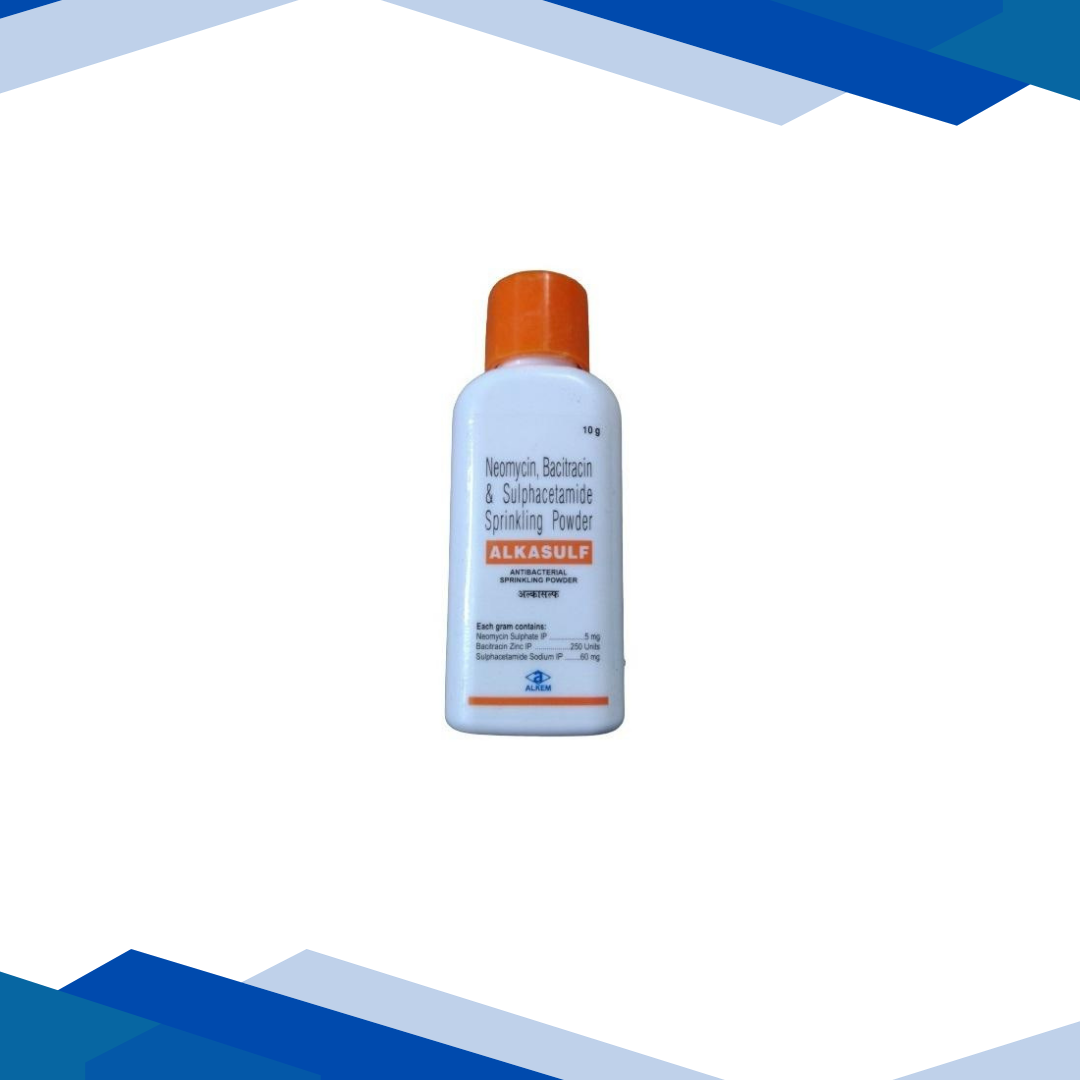
Alkasulf Powder
No Prescription yet? Don’t worry! Click Here to Get Online Consultation
Alkasulf Sprinkling Powder is used for preventing and treating skin infections, especially minor cuts, wounds, burns, and abrasions.For more details kindly click on Medicine Salts below:
Bacitracin
Bacitracin Ointment: The Go-To First Aid for Skin Infections
Bacitracin Ointment is a crucial ingredient for skin infection control because it is very effective against infections caused by minor skin cuts. The ointment helps to shield skin, allowing it to heal both underground and above the skin surface.
How Bacitracin Works
Through its action, Bacitracin helps not by simply killing bacteria (which is the way some antibiotics act), but rather as a cell-wall synthesis inhibitor. In simpler terms, Bacitracin stops the bacteria from developing their protective exoskeleton. Naturally without this "skin," the bacteria won't be able to survive or even multiply. This then helps the immune system in cleaning up the infection more thoroughly and effectively.
Key Advantages & Uses
Wound Protection: Bacitracin is ideal for minor cuts, scrapes, or abrasions.
Preventive Action: Prevents common bacteria such as staph and streptococcus from entering broken skin.
Postoperative Care: Is often recommended post minor dermatological procedures to ensure a clean site.
Calming Effect: With such a goopy base, the ointment assures the wound stays wet, which is the key to minimal scarring.
Expert Advice on the Use of Bacitracin
Cleansed: Always cleanse the affected area gently with a mild soap and water, and then pat dry, before applying the ointment. It will only "trap" bacteria in the dirt there.
A Little Is More: You only need a thin smear. Layering on unneeded amounts doesn't make it heal faster, it only creates a mess.
The Seven-day Rule: A week after using Bacitracin, cease its use and see a doctor—it could become necessary to switch treatment.
Monitor Signs of Toxicity: Even though it is rare, some people are allergic to bacitracin, thus, itching, peeling, or increased redness and swelling should be removed and further advice sought.
Side Effects
Most people tolerate Prisbutan very well. But watch for:
Skin irritation — very mild.
Yes—it causes pruritis at the site of the indicated location.
Severe (but rare) allergic reactions: Seek emergency medical support if you experience hives, difficulty breathing, or swelling of the lips, face, and/or throat.
Should the following wonderful events occur, one must be grateful: each visit will get the person smaller; mils of germs move from our cottages and back to our arsenal——dead and out of God's way! A beautiful sixty-piece orchestra of pure good health will disinherit one of the shadow-world, and will make any man both physically and spiritually sound!
How to Use: Step by Step
Ensure careful washing of hands in order to prevent transfer of new germs to the site.
Clean the wound gently and assure that the wound is completely dry.
Rub a very small amount about the volume of a pea on the treated part 1 to 3 times daily.
Then, cover with a bandage if the treated area might become dirty or rub against clothes.
Wash hands once more after this.
Questions and Answers (FAQs)
Q: Is Bacitracin the same as Neosporin?
Not really. Bacitracin has only Bacitracin antibiotic in it, while Neosporin is a "Triple Antibiotic Ointment," as it has Bacitracin, Neomycin, and Polymyxin B combined in it. Bacitracin is found most useful for those who have very sensitive skin or an allergy to neomycin.
Q: Can I use this ointment for pimples?
It's generally not recommended. Bacitracin is generally of benefit in treating surface wounds, "surface" bacteria, and not for the kind that cause acne, which is Propionibacterium acnes. Using it for acne might even cause more clogged pores.
Q: Are my babies safe?
They should usually be safe to use if cut is minor for a child; however, for children under 2, you should consult with a pediatrician. The first time they are introduced to a product, consider doing a spot test first.
Q: Can I apply Bacitracin in the eyes?
Rapidly rush the eye under cool water if Bacitracin skin ointment gets in your eye. Bacitracin Eye Ointment is the proper product.
Q: Does it expire?
Yes, you should find the expiration date on the crimp at the base of the ointment tube before each use. Efficiency can decrease if the ointment has expired. If the tube was open for several years, the ointment may also harbour bacteria.
Neomycin
Neomycin Topical Sulfate (USP/IP)
Neomycin is a potent aminoglycoside antibiotic used to treat and prevent bacterial skin infections. It works by inhibiting bacterial protein synthesis, thereby stopping the growth and multiplication of bacteria. It is effective mainly against gram-negative and some gram-positive organisms, and is commonly included in “triple antibiotic” ointments for minor skin care.
Therapeutic Uses
Infected Minor Wounds: Prevents infection in cuts and abrasions
Minor Burns: Protects damaged skin from secondary bacterial infection
Secondary Skin Infections: Used in eczema or impetigo when infected
Pre-Surgical Prep: Helps in surface sterilization before minor procedures
Salient Features
Localized Action: Works directly at the site of infection
Rapid Effect: Begins acting on surface bacteria quickly
Multiple Forms: Available as creams, ointments, and powders
Usage
Preparation: Wash hands and clean area with soap and water
Application: Apply a thin layer to affected area
Frequency: Use 1–3 times daily as advised
Protection: Cover with a sterile bandage if required
Unwanted Side Effects and Safety
Mild redness or irritation
Itching or stinging sensation
Allergic Contact Dermatitis: rash or hives may occur
Warning: Avoid use on large open wounds due to risk of systemic absorption and rare ototoxicity or nephrotoxicity
Precautions and Warnings
Duration: Do not use beyond 7 days without medical advice
Sensitive Areas: Avoid use in eyes or ear canal
Pregnancy: Use under medical supervision
Pediatric Use: Generally safe for children above 2 years with guidance
Frequently Asked Questions
Q: Can it treat acne?
Not ideal; better options include benzoyl peroxide or clindamycin
Q: What if swallowed accidentally?
Usually causes mild stomach irritation; seek help if large amount ingested
Q: Why is my skin red and itchy?
Possible allergic reaction; discontinue use and consult a doctor
Q: Can it treat fungal infections?
No, it works only against bacterial infections
Q: Can it be used under a dressing?
Yes, but consult a doctor if the wound is severe or highly inflamed
Sulphacetamide
Sulfacetamide Sodium 10% Eye Drops
Sulfacetamide, for being an antibiotic of the sulfonamide type, is very potent with local action. It is solely used ophthalmically. Its target is superficially infective ocular surface such as conjunctivitis in eye care and prophylaxis post corneal abrasion or injury. Being unable to utilize this active site for the construction of folic acid, sensitive bacterial strains cannot produce folic acid and recipient bacteria multiply and grow quickly.
Clinical Indications
Bacterial Conjunctivitis: Aids in reducing redness, discharge, and irritation due to the presence of bacterial invaders in the eye.
Trachoma: Recommended as supportive therapy in chronic infectious eye conditions.
Corneal Ulcers: Enables healing with protection from secondary bacterial infections to the eye.
Blepharitis: Dealing with the eyelids' inflammation when bacterial infection occurs.
Pathways of Action
Sodium sulfacetamide inhibits the bacterial enzyme dihydropteroate synthetase, where dihydropteroate is PABA bound. Since bacteria need PABA for synthesizing folic acid for cellular reproduction, the sulfacetamide delivers a competitive starvation of the bactericidal nutrient required for growth, giving rise to a bacteriostatic agent that stops growth.
Use:
- Preparation: Wash hands thoroughly with soap and water before use.
- Method of administration: Point the face toward the sky and gently pull down the lower eyelid to form a pocket. Administer drops without touching the tip of the dropper to the eye or eyelids.
- Dosage: Instill one or two drops in the affected eye(s) every one to three hours during the day or as directed by the ophthalmologist.
- Closing: Keep the eyes gently closed for a short time to allow proper absorption of the medication.
Side Effects
In addition to the above, hypersensitive individuals could experience:
A brief, mild stinging or burning following instillation.
Sensitivity to light (photophobia)
Temporary blurry vision
Eyelid swelling or itching
Safety Information: If you develop a skin rash, significant swelling, or joint pain while using this medication, stop usage immediately and consult a healthcare provider, as these could indicate a serious sulfonamide allergy.
Precautions & Storage
Contact lenses: Do not wear contact lenses during an active eye infection. Wait at least 15 minutes after instillation before wearing lenses, unless advised otherwise.
Contamination: Do not touch the dropper tip to any surface. Replace the cap tightly after use.
Color of Solution: If the solution turns dark brown or contains particles, discard it and use a new bottle.
Storage: Store at room temperature. Do not refrigerate. Protect from light.
Frequently Asked Questions (FAQs)
Q: Can I use Sulfacetamide drops for viral or fungal eye infections?
No. It is effective only against bacterial infections.
Q: How long should I continue the treatment?
Complete the full course even if symptoms improve to prevent recurrence and resistance.
Q: Can Sulfacetamide be used for acne?
It is available in topical forms for acne, but eye drops should never be used on the skin.
Q: Is it safe for children?
Yes, it is generally safe for children above two months, but dosage should be confirmed by a pediatrician.
Q: What if I miss a dose?
Use it as soon as you remember. If it is close to the next dose, skip the missed one. Do not double the dose.
Health Professional's Note
Do not share eye drops, as eye infections are highly contagious. Avoid rubbing the eyes and use a clean towel daily until the infection resolves.
Disclaimer: The information provided is for educational purposes only and should not replace professional medical advice. Always read the medication leaflet and consult a healthcare provider before use.
At Gem Pharmacy, we make every effort to provide accurate, expert-written, and thoroughly reviewed information related to medicines. However, this information should not be considered a substitute for professional medical advice, diagnosis, or treatment from a qualified doctor.
The purpose of this information is to educate users and improve communication between patients and healthcare professionals. It should not be used to diagnose or treat any condition.
Always consult a certified healthcare professional before taking any medication.


Related products