

Showing the single result
Filter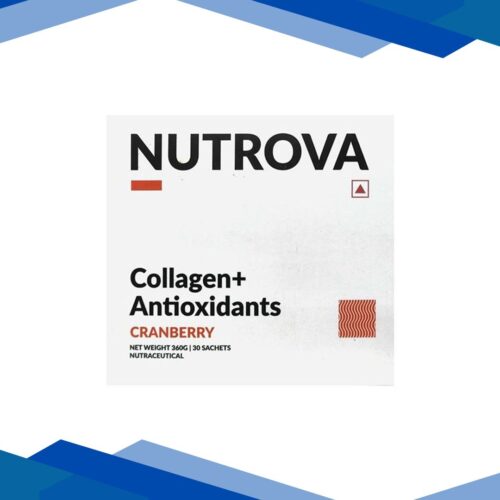
NUTROVA COLLAGEN + ANTIOXIDANTS CRANBERRY Sachet 30’s
Collagen Peptides: Bioactive Structural Support
The Collagen Peptides (also known as Hydrolyzed Collagen) are a short chain of amino acids forming after the disintegration of longer collagen fibers. The process of enzymatic hydrolysis makes large, hard-to-digest collagen molecules split into high molecular weight “peptides.” In comparison to native collagen, these peptides are characterized by their high solubility and their high quantity absorption; hence, they travel along with blood till they reach the ‘target zones” in the dermis of the skin, the joints’ matrix, and bone structure.
Method of Action: “Signaling” Effect
With collagen peptides considered as true raw materials, these peptides also act as chemical ‘signals’ (signaling messengers that trigger or initiate the specific response from the cellular components of the body):
Activation of the Fibroblasts: Once inside the body, they tell fibroblasts present in the skin to stimulate the production of fibres of collagen, elastin, and hyaluronic acid; consequently, the skin can start looking younger!
Protection of Cartilage: In the joints, they stimulate chondrocytes (cartilage cells) to form the “cushion” between bones, thereby ensuring that the painstaking friction that the bones cause does not trigger severe pain.
Specific Amino Acids: They are mostly composed of hydroxyproline, glycine, and proline—an uncommon combination among protein sources, including whey or soy.
Quick Look at the Product
Feature Detail
Source Marine (Fish), Bovine (Cattle), or Chicken
Molecular Weight Usually 2,000 to 5,000 Daltons (giving high absorption)
Primary Uses Skin Elasticity, Joint Health, Bone Density
Form Powder, Tablets, Oral Liquid
Dietary Status For Nutraceutical (Non-Veg Source)
Primary Medical & Aesthetic Benefits
Anti-Aging: Reduces fine lines and increases skin hydration
Support for Joints: Assists efficient joint treatment in old age through reduction of pain and stiffness in bone areas
Super-Hair & Nail Health: Collagen provides the raw amino acids that are essential for keratin, displaying itself in less brittle nails and hair that feels thicker.
Gut Health: Emerging research suggests that collagen peptides may be helpful in maintaining the integrity of the intestinal lining (“gut barrier”).
Popular Brands in India (2026)
In India, collagen peptides are often formulated with Vitamin C or Biotin for better results:
Ch-Alpha (Gelita)
Cartigen Forte (Pharmed)
Collaflex (Paladin)
Freeflex Forte
Inlife / Wellbeing Nutrition (Premium Marine variants)
Usage & Safety Guidelines
Expert tip: Ensure “Vitamin C” is mentioned on the label. There is absolutely no way that you can cross-link collagen fibers effectively without Vitamin C. If your supplement doesn’t have it (like the powders from Indian markets), just remember to take it with a glass of lemon or orange water for maximum effectiveness.
Important Precautions:
Allergy Alert: Fish-derived marine collagen may be a bad choice for those allergic to fish; instead, try bovine (cattle) or porcine sources of collagen.
The “Vegetarian” Myth: Collagen is an animal protein. There is nothing like “Vegan Collagen.” These are actually “Collagen Builders,” and hence, not direct collagen peptides.
Kidney Health: Anybody who is on a protein-restricted diet because of its negative impact on the kidneys should discuss his/her plan with a nephrologist before beginning a high-dose collagen regiment.
Possible Side Effects
Collagen peptides are considered Generally Recognized as Safe (GRAS). However, some users may experience:
A lingering “meaty” or “fishy” after-taste (more common with lower-quality powders).
Mild bloating or heaviness in the stomach.
Less commonly, heartburn.
FAQs
1. Is it better to take Collagen in the morning or at night?
There is no “perfect” time, but many experts suggest taking it in the morning on an empty stomach for better absorption, or at night to coincide with the body’s natural repair cycle during sleep.
2. What is the difference between Type I, II, and III Collagen?
Type I & III: Best for skin, hair, and bone health (mostly found in Marine and Bovine collagen).
Type II: This type focuses particularly on joint cartilage (mostly found in Chicken-derived collagen).
3. How much Collagen should I take daily?
For skin and joint health, most clinical studies recommend doses between 5g and 10g (5,000mg to 10,000mg) a day. Lower doses take a longer time to have visible results.
4. Would Heating Collagen powder in (e.g. coffee) destroy the powder?
Coffee lovers should pay close attention here. There is no evidence to show that the heating of collagen powder damages it in some way. Heating collagen peptides will not denature the peptides or reduce their efficacy when added to hot coffee, tea, or soups.
5. Will Collagen make me gain weight?
Collagen is not one of those proteins that make you gain loads of weight. This is a pure protein with very few calories (35–40 calories per roughly 10g dose), and might even help you feel full for a longer period.
Important: The content presented may only be regarded as an informational material. As a nutritional supplement, Collagen is perfectly safe. However, it cannot replace medical treatment for chronic skin or joint disorders. Always consult with your physician before introducing any new supplement.