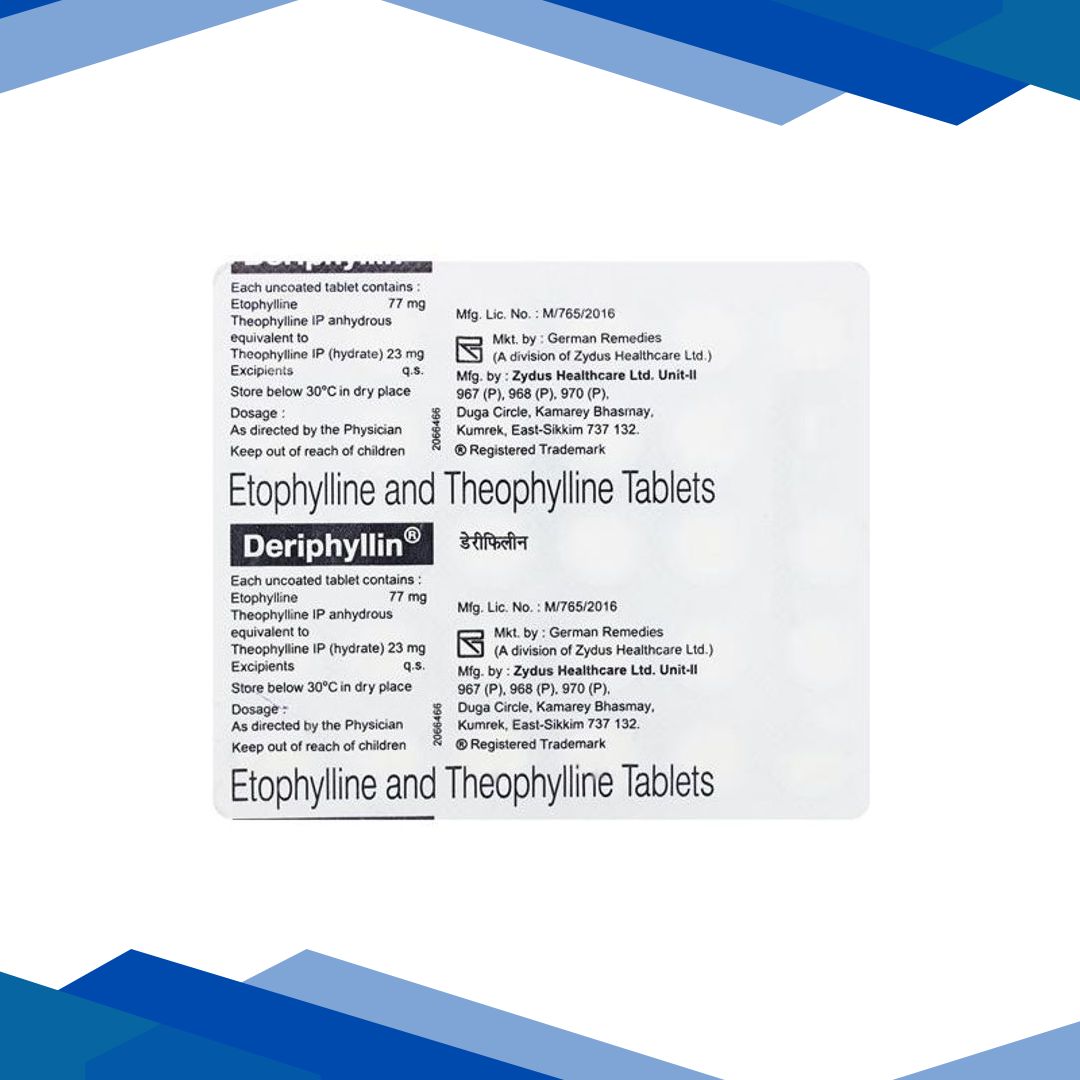
DERIPHYLLIN Tablet 30’s
DERIPHYLLIN Tablet is a purified prescription medicine made from a bacterial protein that works by temporarily blocking nerve signals to specific muscles or glands. This reduces muscle tightening and can also decrease excessive sweating or certain types of gland activity. It is commonly used by trained healthcare professionals to help improve conditions such as muscle spasms, cervical dystonia, chronic migraine, overactive bladder, spasticity, and severe underarm sweating. In aesthetic medicine, it is also used to soften the appearance of facial lines caused by repeated muscle movement. Its effects are temporary and wear off over time, so repeat treatment may be needed. Because it acts directly on nerves and muscles, it should be given only under medical supervision.
Description
DERIPHYLLIN Tablet is a purified neurotoxic protein used in carefully controlled, very small amounts for a variety of medical and cosmetic purposes. it works by temporarily blocking the release of acetylcholine, a chemical messenger that nerves use to signal muscles to contract. when this signal is interrupted, the targeted muscle relaxes for a period of time. this mechanism is the reason it is used in conditions where excessive muscle activity, muscle spasm, or unwanted repetitive movements need to be reduced.
in medical practice, DERIPHYLLIN Tablet is used to treat several conditions involving abnormal muscle contraction or excessive nerve signaling. these may include certain types of muscle stiffness, eyelid spasms, neck muscle tightening, chronic migraine prevention in appropriate patients, and some bladder disorders. in aesthetic care, it is also widely used to temporarily soften the appearance of dynamic facial lines caused by repeated muscle movement. because its action is localized and temporary, treatment usually needs to be repeated at intervals under professional supervision.
this medicine must be handled and administered by trained healthcare professionals. the exact preparation, injection technique, and treatment area depend on the condition being treated. while it can provide meaningful symptom relief and cosmetic improvement, it is not a permanent cure and does not replace the need for proper diagnosis, follow-up, or supportive therapy when needed. its safety and effectiveness depend heavily on correct patient selection, correct administration, and careful monitoring for side effects.
DERIPHYLLIN Tablet is not suitable for self-use. it should only be used after evaluation by a qualified clinician who understands the risks, benefits, and contraindications. people with certain neuromuscular disorders, swallowing problems, breathing issues, or allergies may need special caution or may not be appropriate candidates. a thorough medical history is essential before treatment.
ingredients
- DERIPHYLLIN Tablet: the active ingredient is the purified botulinum neurotoxin type a. it is the component responsible for blocking nerve signals to muscles. in therapeutic use, it is highly diluted and administered in controlled amounts to produce a temporary, localized effect on muscle activity or gland function.
- stabilizing proteins or formulation components: depending on the brand or product presentation, the preparation may contain proteins or excipients that help preserve stability and maintain activity until reconstitution and use. these ingredients do not provide the therapeutic effect themselves but support product handling and storage.
- preservative-free or preservative-containing diluent: some formulations are prepared for reconstitution with sterile normal saline or another recommended diluent before injection. the diluent helps create the correct concentration for administration but is not the active treatment ingredient.
- inactive formulation aids: certain products may contain salts or buffering agents that help maintain the stability, ph, or consistency of the injectable preparation. these components vary by manufacturer and do not change the core mechanism of action of DERIPHYLLIN Tablet.
key uses
- temporary reduction of muscle overactivity: it is used to relax specific muscles that are contracting too strongly or too often, helping reduce stiffness, spasms, or involuntary movements in a targeted area.
- chronic migraine prevention: in suitable patients, DERIPHYLLIN Tablet may help reduce the frequency of migraine headaches over time when given by a trained specialist according to established treatment protocols.
- management of eyelid and facial spasms: it can be used to lessen involuntary blinking, eyelid twitching, or facial muscle contractions that interfere with normal function or comfort.
- neck muscle spasm and cervical dystonia: it helps reduce painful, sustained contractions in neck muscles that can cause abnormal head posture, pain, or restricted movement.
- bladder-related conditions: in selected patients, it may be used to help control overactive bladder symptoms, including urgency and frequent urination, by relaxing the bladder muscle.
- excessive sweating: it may be used to reduce severe sweating in certain body areas by temporarily blocking the nerve signals that stimulate sweat glands.
- cosmetic improvement of dynamic wrinkles: it is commonly used to soften expression lines caused by repeated facial movement, such as forehead lines, frown lines, and crow’s feet.
how to use
DERIPHYLLIN Tablet should only be administered by a qualified healthcare professional in a clinical setting. it is generally given as a series of small injections into specific muscles or tissues, depending on the condition being treated. before treatment, the product is usually reconstituted according to the manufacturer’s instructions, and the clinician selects the injection sites based on the medical problem, anatomy, and desired treatment outcome.
the effect is not immediate. most people begin to notice improvement after several days, while the full benefit may take up to a couple of weeks depending on the indication and response. the treatment effect is temporary, so follow-up sessions are often required after the effect wears off. the interval between treatments varies widely based on the condition, the formulation used, and individual response. patients should not try to adjust, repeat, or combine treatments on their own.
after injection, people are usually advised to avoid rubbing or massaging the treated area unless instructed otherwise. they should follow all aftercare instructions carefully, especially if the treatment is for the face, neck, bladder, or another functionally important area. if unusual symptoms occur, such as difficulty swallowing, breathing changes, marked weakness, or vision problems, urgent medical attention is needed.
safety information
- warnings: DERIPHYLLIN Tablet can spread beyond the intended injection area in rare cases and cause unwanted muscle weakness. this may lead to swallowing difficulty, speech problems, breathing problems, or generalized weakness. people with neuromuscular diseases may be more sensitive to its effects. it should be used only by trained professionals with appropriate expertise.
- side effects: common side effects may include pain, swelling, redness, bruising, headache, localized weakness, mild flu-like symptoms, or temporary discomfort at the injection site. more serious side effects can include drooping eyelid, blurred vision, double vision, difficulty swallowing, hoarseness, trouble breathing, widespread muscle weakness, urinary retention, or allergic reactions.
- precautions: use caution in people with myasthenia gravis, lambert-eaton syndrome, amyotrophic lateral sclerosis, breathing disorders, swallowing difficulties, or a history of aspiration. extra care is needed in patients who have facial asymmetry, prior surgery in the treatment area, infection at the injection site, or those taking medicines that affect neuromuscular transmission.
- pregnancy/breastfeeding: safety data in pregnancy are limited. DERIPHYLLIN Tablet is usually avoided unless the expected benefit clearly outweighs possible risk. breastfeeding safety is also not fully established, so treatment during breastfeeding should be discussed carefully with a clinician.
- interactions: drugs that may increase the risk of weakness or enhance its effect include aminoglycoside antibiotics, other neuromuscular blocking agents, certain muscle relaxants, and some medicines that interfere with nerve-muscle signaling. alcohol does not directly interact in the same way, but it may worsen dizziness or impair judgment after treatment in some people.
additional information
- storage: store according to the product label and manufacturer instructions, usually under controlled refrigeration before reconstitution and protected from light when required. do not freeze unless the specific formulation allows it. once prepared, it should be used within the recommended time frame set by the manufacturer or clinic policy.
- missed dose: because DERIPHYLLIN Tablet is administered by a healthcare professional on a schedule, a missed treatment session should be rescheduled as soon as practical. do not self-administer or attempt to “make up” a missed session without professional guidance.
- overdose: an overdose may cause excessive muscle weakness, difficulty swallowing, breathing problems, or other serious symptoms. this is a medical emergency. if overdose is suspected, seek urgent medical care immediately.
- habit forming: no. DERIPHYLLIN Tablet is not known to be habit forming or addictive. however, repeated treatments may be needed because its effects are temporary, not because it causes dependence.
frequently asked questions
Q: what is DERIPHYLLIN Tablet used for?
A: DERIPHYLLIN Tablet is used for selected medical and cosmetic purposes, including reducing muscle spasms, preventing certain migraines, treating some bladder and sweating conditions, and temporarily softening expression lines. the exact use depends on the clinical need and treatment plan prescribed by a healthcare professional.
Q: how long does DERIPHYLLIN Tablet take to work?
A: it usually does not work immediately. many people begin to notice improvement within several days, while the full effect may take up to about two weeks, depending on the treated area and condition.
Q: how long does the effect last?
A: the effect is temporary and commonly lasts for several weeks to a few months. duration varies by condition, dose, treated area, and individual response. repeat treatment may be needed under medical supervision.
Q: is DERIPHYLLIN Tablet safe?
A: it can be safe when used correctly by a trained professional in appropriate patients. however, it carries important risks, including spread of toxin effect, weakness, swallowing problems, and breathing issues. a medical evaluation is essential before use.
Q: can i use DERIPHYLLIN Tablet at home?
A: no. it should not be used at home or self-injected. it requires careful preparation, precise injection technique, and professional monitoring to reduce the risk of serious complications.
Q: what are the most common side effects?
A: common side effects include pain, redness, swelling, bruising, headache, or temporary weakness at the injection site. more serious side effects are uncommon but can occur and require urgent medical attention.
Q: who should avoid DERIPHYLLIN Tablet?
A: people with certain nerve or muscle disorders, active infection at the injection site, significant swallowing or breathing problems, or a history of allergy to the product may need to avoid it or use it only with special caution. a clinician should review your medical history first.
Q: can DERIPHYLLIN Tablet be used during pregnancy?
A: it is generally avoided during pregnancy unless the potential benefit clearly outweighs the possible risk. if you are pregnant, planning pregnancy, or breastfeeding, discuss the risks and benefits with your healthcare professional.
Q: does DERIPHYLLIN Tablet interact with other medicines?
A: yes. it may interact with medicines that affect nerve-to-muscle communication, including some antibiotics and muscle relaxants, which can increase the risk of weakness. tell your clinician about all medicines and supplements you use.
Q: what should i do if i have trouble breathing after treatment?
A: seek emergency medical attention immediately. difficulty breathing after DERIPHYLLIN Tablet treatment can be a serious sign of toxin spread or another complication and should not be ignored.
this information is for educational purposes only and should not be considered medical advice. always consult a qualified healthcare professional before use.
At Gem Pharmacy, we make every effort to provide accurate, expert-written, and thoroughly reviewed information related to medicines. However, this information should not be considered a substitute for professional medical advice, diagnosis, or treatment from a qualified doctor.
The purpose of this information is to educate users and improve communication between patients and healthcare professionals. It should not be used to diagnose or treat any condition.
Always consult a certified healthcare professional before taking any medication.


Related products
Dericip Retard 300mg Tablet 10’S