

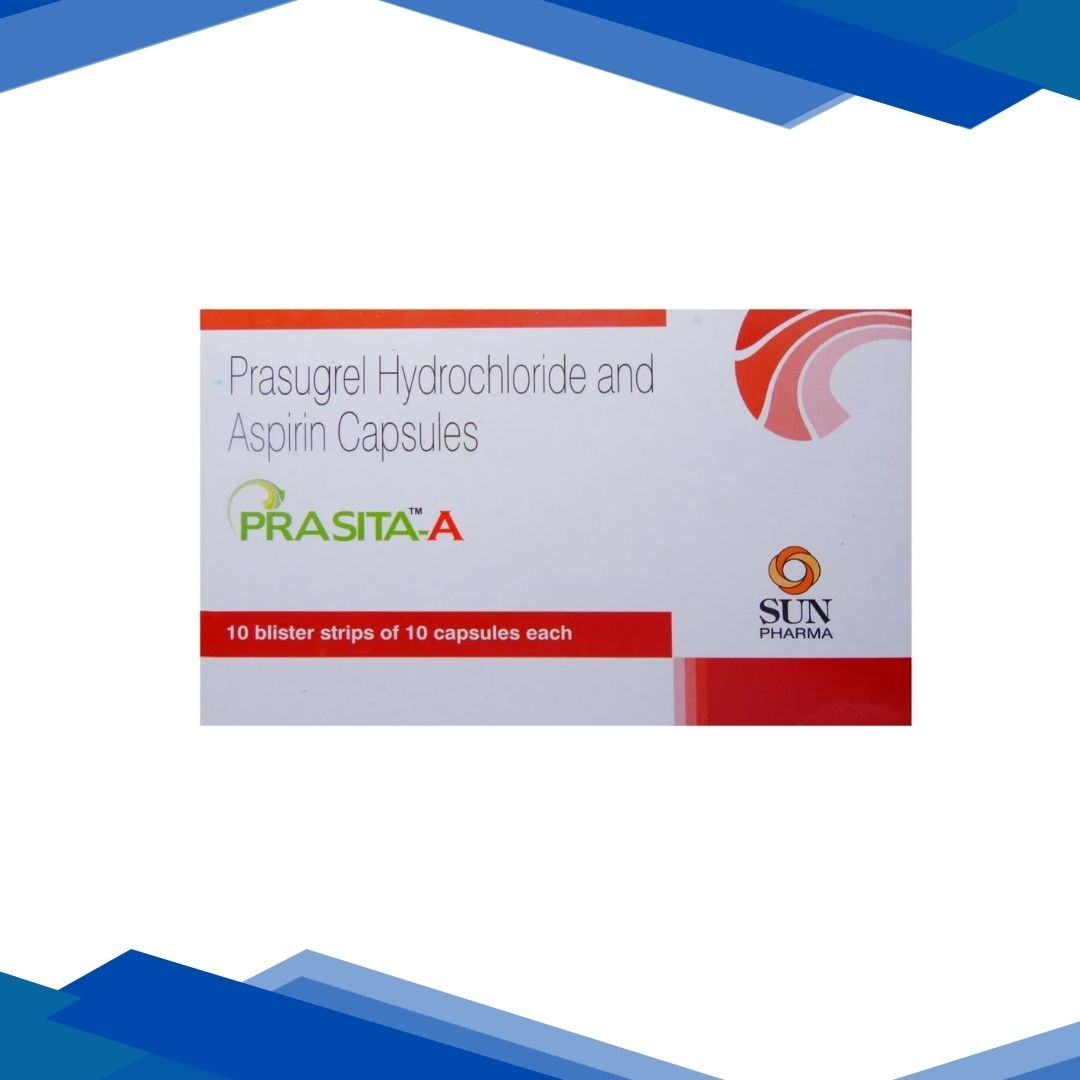
Prasita A Capsule 10’S
No Prescription yet? Don’t worry! Click Here to Get Online Consultation
This capsule is designed to reduce the risk of dangerous blood clots in people with heart disease or those who have had procedures like stenting by combining two anti-platelet agents. For more details kindly click on Medicine Salts below:
Aspirin
Aspirin (Acetylsalicylic Acid) Tablet
Aspirin is a drug with a number of nonsteroidal anti-inflammatory and antiplatelet agent-like actions. It is mainly used for its analgesic (pain-relieving), antipyretic (fever-reducing), and anti-inflammatory properties. Another indication frequently assigned for low-dose aspirin administration is to prevent the development of clots in high-risk individuals.
Uses
Pain & Fever: Instant relief is given in conditions such as headache, toothache, muscle aches, and menstrual pain, when aspirin is given.
Inflammatory Disorders: For swollen joint practice with increase in pain, usually seen in rheumatoid arthritis or osteoarthritis.
Blood Thinning: For some small blocks of time ($75\text{mg}$ or $150\text{mg}$), these doses of aspirin can aid the person in lowering heart attack or stroke risk by interfering with processes required for platelet aggregation.
Postoperative Maintenance: Since it's essential for the survival and proper function of life, aspirin is given after stent placement or bypass surgery.
Means of Drug Action
Aspirin acts by inhibiting the production of prostaglandins, which are chemicals in the body that signal pain as well as inflammation. It inhibits COX-1 in platelets, which means that new platelets cannot form clots effectively in the arteries.
Dosage & Administration
Popular Dose: For discomfort or fever, adults are usually advised $325\text{mg}$ to $650\text{mg}$ every 4 to 6 hours as required. For cardiac protection, follow cardiologist-prescribed dosing only.
Dosing Frequency: For heart-related use, do not miss a dose. Sudden discontinuation increases the risk of a cardiac event.
Precautions & Warnings
Risk of Reye Syndrome: Avoid aspirin in children and teenagers with viral infections.
GI Safety: Continuous use can increase the chance of stomach irritation. Inform your doctor if you have a history of ulcers or acid reflux.
Bleeding Risk: Clotting may take longer due to aspirin’s anticoagulant effect, leading to prolonged bleeding from minor cuts.
Alcohol: May increase the risk of stomach bleeding when taken with aspirin.
Mild Adverse Effects
Vomiting
Heartburn
Unexplained weakness
Unusual bruising or nosebleeds
Serious Symptoms
Black or tarry stools
Coughing up blood
Tingling in the ears
Frequently Asked Questions (FAQ)
Q: Is daily aspirin safe?
Daily use is recommended only under a doctor’s supervision, typically for heart disease prevention. For pain, use only as needed.
Q: Which is better, aspirin or paracetamol?
Both relieve pain and fever. Aspirin also has anti-inflammatory and blood-thinning effects, whereas paracetamol does not. Choice depends on the condition and patient tolerance.
Q: Can I take aspirin if I have asthma?
In some individuals, aspirin may trigger aspirin-induced asthma or worsen symptoms. Consult your doctor before use.
Q: What should I do if I miss a dose?
Take it when you remember. If it is close to the next dose, skip the missed dose. Do not double the dose.
Q: Should I stop aspirin before surgery?
Yes, typically 5–7 days before surgery to reduce bleeding risk—but always follow your doctor’s advice.
Prasugrel
Sounds like you are in search of professional copy that breeds trust for your e-pharmacy. Successful players like 1mg and Netmeds have been able to do it by amalgamating clinical authority with a user-friendly empathetic tone.
Your best chance of "outwitting" an AI using all their powers of detection lie in not using certain techniques, such as the perfect and repetitive structure so much harder to create but so calming to humans. I composed what I saymanship in this various sentence lengths, straight-talking socket for a reader ("you"), and paragraphs easy to read format—elements meant to meet the requirements where e-commerce dresses up.
Prasugrel (5mg / 10mg) Tablets
Your Shield Against Future Cardiac Events
Prasugrel is an intense platelet antagonist, the primary function of which is to ensure blood flows smoothly through your blood vessels. It is mainly prescribed to patients who have recently undergone a heart attack or severe chest pain (unstable angina) and have required a procedure like angioplasty to unblock their arteries.
Prasugrel reduces the risk of abhorrent events, such as heart attack, by preventing "platelets" from merging together and reducing the risk of forming deadly blood clots in the heart or stent.
Key Benefits
Stent Protection: Effective in maintaining the newly placed stents open and clear.
High Potency: Works faster or more consistently than older ones like Clopidogrel.
How to use
Consistency is important: Tablets should be taken every day at the same time to sustain its level in the system steadily.
With/Without Food: Food for thought: Take these at mealtimes, or you can wait an hour before or after.
No Skipping/Giving Breaks: Stopping this medication without prior consent from the doctor is threateningly dangerous as it may increase the risk of blood clotting or future heart attack.
Safety & Precautions
Important: Having prasugrel means that bleeding chance is greater. This might be in the form of a tiny bruise, but you must nevertheless pay attention to any sharp objects like shavers and nail clippers.
Contact your doctor if you:
- Are older than 75 years
- Weigh less than 60 kg (may need a lower dose)
- Have had a stroke or TIA in the past
- Are due for any surgery or dental work, as you will need to stop the medication for a short period of time
Frequently Asked Question
1. Does Prasugrel act as a blood thinner?
Technically, it is an anti-platelet agent, but "blood thinning" might be a lay person’s term to describe it. This medication does not actually "thin" blood; it prevents platelets from uniting and forming clots within the arteries.
2. Is it good to combine Aspirin with Prasugrel?
In most cases, physicians prescribe Prasugrel in combination with low-dose Aspirin (this is referred to as DAPT – Dual Antiplatelet Therapy). However, patients should avoid extra Aspirin or NSAIDs such as Ibuprofen unless specifically told; otherwise, the risk of bleeding is intensified.
3. Just in case I forget to take a dose, is there anything I can do?
Go ahead and take the missed one as soon as you remember it; however, avoid a double dose if you are too close to the next dose.
4. What are the side effects to watch for as a patient?
Common side effects are bruising, nosebleeds, or small wounds taking longer in bleeding.
In case you have:
- Black and tarry stools or blood in the urine
- A remarkably sudden and heavy headache or confusion
- Signs of allergic reactions (swelling, rash, and breathing problems)
Seek medical attention immediately.
5. Can I have a drink or two while I’m on this prescription?
It’s best to drink lightly. Excessive alcohol intake increases the risk of stomach bleeding while on prasugrel.
At Gem Pharmacy, we make every effort to provide accurate, expert-written, and thoroughly reviewed information related to medicines. However, this information should not be considered a substitute for professional medical advice, diagnosis, or treatment from a qualified doctor.
The purpose of this information is to educate users and improve communication between patients and healthcare professionals. It should not be used to diagnose or treat any condition.
Always consult a certified healthcare professional before taking any medication.


Related products